Legal Professional
Social Content for Solo Attorneys and Self-Employed Law Practitioners
Solo practitioners operate their own law practice—which means variable income, inconsistent documentation, and complex qualification challenges. Your social content for this audience should acknowledge that their income is legitimate, documented differently than W-2 employees, and absolutely financeable with the right lender. This segment responds to content that normalizes self-employment and positions you as someone who understands solo practice economics.
How does a solo attorney's income look different to mortgage lenders?
Solo practitioners live with income volatility, seasonal fluctuations, and the constant refinement of their practice. Mortgage lenders expect to see tax returns, profit-and-loss statements, and business bank statements. Social content for this audience should demystify the documentation process and show that self-employment income is not a dealbreaker—it's just evaluated differently.
- Documentation: lenders want two years of tax returns (Form 1040 + Schedule C), business bank statements, and profit-and-loss statements
- Volatility is normal: lenders expect solo practice income to fluctuate; they average it over two years or use the most recent year, whichever is lower
- Business vs. personal income: some solo attorneys comingle income and expenses; clean accounting helps underwriting
- Deductions matter: legitimate business deductions (office, staff, malpractice insurance) reduce taxable income but may also reduce the income used for qualification
- Growth trajectory helps: if your income is trending upward, document that; lenders like to see evidence of a growing practice
What are the best loan programs for self-employed attorneys?
Solo attorneys have options beyond traditional conforming mortgages. Bank statement loans, no-doc programs, and portfolio lending exist specifically for borrowers whose income doesn't fit the W-2 mold. Content should introduce these programs and explain when each makes sense—this is where you showcase expertise.
- Bank statement loans: use 12-24 months of bank statements instead of tax returns; good for newer practices or those with complex deductions
- Self-employed mortgages: traditional programs for self-employed borrowers with clean tax returns and documented income
- Asset-based loans: evaluate net worth and assets rather than just income; useful for high-net-worth solo attorneys
- Portfolio loans: held by the lender, allowing flexibility for complex income; often have competitive rates for professional borrowers
- Stated-income programs: less common post-2008, but some lenders offer them for well-documented borrowers with excellent credit
What content messaging resonates with solo attorneys and independent practitioners?
Solo attorneys value directness, practical advice, and proof that you understand the self-employed experience. They're busy and skeptical of hype. Content should be substantive, acknowledge the challenges, and provide clear guidance. Referrals and peer recommendations carry massive weight.
- Share stories of solo attorneys who closed mortgages with bank statement loans or portfolio products
- Address the myth that self-employment disqualifies you; reframe it as a different documentation path
- Offer a free consultation specifically for solo practitioners; highlight your experience with self-employed borrowers
- Create content around documentation preparation: how to organize tax returns, business statements, and profit-loss sheets
- Partner with accounting firms and business advisors serving solo attorneys; cross-refer clients and build joint content
How do you help solo attorneys prepare their mortgage application?
Preparation separates fast closings from slow ones. Solo attorneys benefit from a pre-application checklist and clear guidance on what lenders will need. Export content as downloadable preparation guides, email workflows, and consultation frameworks that position you as the expert who removes friction.
- Create a pre-application checklist specific to self-employed borrowers: documentation, timeline, credit prep
- Develop a bank statement loan guide: which lenders offer them, what they evaluate, timelines, and costs
- Build email sequences that walk solo attorneys through the qualification process step-by-step
- Host educational webinars for bar associations or practice management groups; position yourself as a resource
- Create comparison content: bank statement loan vs. traditional mortgage vs. stated-income; help borrowers choose the right path
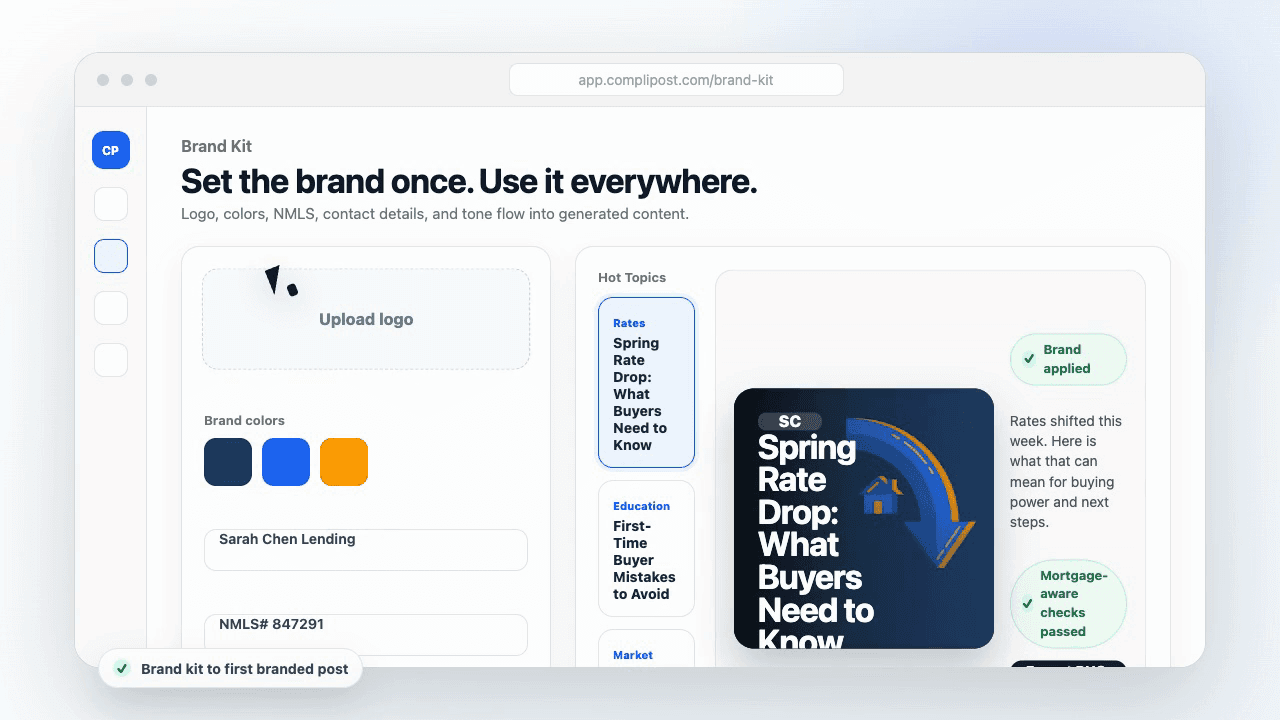
Product workflow
From blank page to export-ready mortgage content
- Start with a borrower topic
- Generate copy and a visual direction
- Review, save, and export the finished asset
These previews reflect the core CompliPost workflow: create, review, save, and export assets for use in your own channels.
Workflow comparison
| Content approach | What happens | Why it matters |
|---|---|---|
| Random posting | One-off ideas created when there is spare time | Inconsistent visibility and weak reuse |
| Template-only posting | Faster design but still requires rewriting and review | Helpful starting point, but not a full system |
| CompliPost workflow | Plan, generate, review, save, and export from one place | Better consistency with mortgage-aware review context |
| Done-for-you service | Someone else creates much of the content | Useful for some teams, but less control and less immediate reuse |
Who this guide helps
This guide is for loan officers working on solo loan officers who need a repeatable mortgage content workflow. The goal is to turn a broad mortgage topic into one borrower question, one useful takeaway, and one asset that can be reviewed before it is shared.
- You need content that sounds like a loan officer, not a generic brand account
- You want examples that can become captions, graphics, GIFs, or PDFs
- You need a clear place to review claims before export
- You want finished work saved for reuse, not lost in a chat thread
A practical workflow for this use case
Start with a narrow scenario, then move through planning, drafting, visual creation, review, and export. For solo attorney self-employed mortgage content, that means the topic should be specific enough that a borrower or referral partner can immediately understand what decision the content helps with.
- Choose the borrower type, loan topic, or platform before generating copy
- Draft the caption and visual together so the asset feels cohesive
- Use the federal baseline review aid to flag claims and disclosure gaps
- Export the finished asset and save the post as a reusable starting point
What makes the content stronger
Strong mortgage content is usually specific, plain-spoken, and calm. It explains tradeoffs without pretending one answer fits every borrower. That is especially important on public social channels, where a short post can be interpreted without the full context of a loan conversation.
- Name the borrower question in the first line
- Explain one decision or tradeoff instead of covering everything
- Use examples without implying approval, savings, or rate outcomes
- End with a soft next step, checklist, or guide rather than pressure
Compliance-aware review notes
CompliPost should be treated as a review aid, not a compliance approval system. The public page, generated draft, graphic, and exported asset should all stay honest about that boundary.
- Review specific payment, APR, rate, savings, and qualification language
- Avoid “best,” “lowest,” “guaranteed,” “free,” and urgency claims unless approved
- Check NMLS, Equal Housing, company, and state-specific requirements
- Use company or legal review for anything outside the federal baseline
How this connects to the rest of CompliPost
A focused guide should leave you with a usable next step. After you understand the topic, you can turn it into a calendar slot, a reviewed social post, a downloadable guide, or a platform-specific version for the channel where your audience already spends time.
- Use the content calendar to turn the idea into a weekly plan
- Use the compliance page when claims or disclosures need a slower pass
- Use lead magnets when the topic deserves a deeper PDF guide
- Use platform pages to adapt the same idea for LinkedIn, Facebook, or Instagram
Recommended next steps
Self-employed borrower hub
Create income-documentation education for self-employed borrowers.
Self-Employed Mortgage Specialist Content
Comprehensive content strategy for loan officers working with self-employed borrowers across professions.
Self-Employed Bank Statement Loan Officer Content
Focused content on bank statement loans and alternative underwriting for self-employed professionals.
Attorney Mortgage Guide
Full guide covering mortgage strategies for attorneys at all career stages, including solo practitioners.
Examples
"Solo attorney, variable income, closed in 30 days using a bank statement loan. Here's what made it possible."
Share as a case study on LinkedIn or a longer-form post; detail the documentation process and timeline.
"Your law practice income counts—even if it's not on a W-2. Here's how bank statement loans evaluate self-employed borrowers."
Create an educational carousel or short video explaining bank statement loan underwriting for self-employed professionals.
"Thinking about buying before your practice stabilizes? Three loan options for solo attorneys at different income stages."
Write as a comprehensive email guide or downloadable PDF; include decision criteria for each option.
"Your accounting matters more than you think when you apply for a mortgage. Here's how to organize your books for underwriting."
Email this as a practical checklist; partner with an accountant and cross-promote to solo attorney audiences.
FAQ
How far back do lenders look at my tax returns for a mortgage application?+
Most lenders require two years of federal tax returns (Form 1040 with Schedule C or Schedule C-EZ). Some will use the most recent year if it's higher; others average the two years. A few lenders will look at three years if you're in a practice rebuild or recovery period. The key is consistency and documentation. If your income is trending upward, bring evidence of that growth. If you're in year one of your solo practice, some lenders (using bank statement programs) will overlook the shorter history if your business bank statements show strong deposits. Be upfront with your loan officer about where you are in your practice growth.
What if my practice is new (less than two years old)?+
New practices are trickier but not disqualifying. Some lenders require that you have at least two years of business history. Others—particularly those offering bank statement loans—will evaluate your personal credit, assets, and the strength of business deposits in your first year. You may have a few options: (1) wait until you hit two years of tax returns; (2) pursue a bank statement loan based on deposits; or (3) use a co-signer with more documented income. Talk to your loan officer early; they'll assess your practice strength and guide you toward the best program. Bringing a partnership offer, retainer agreements, or other evidence of client commitment helps.
How much income do business deductions cost me when I apply for a mortgage?+
This is important and often misunderstood. Your *taxable* income (after deductions) is what lenders use for qualification. So yes, legitimate business deductions reduce the income used for your mortgage. This is why some solo attorneys worry about being "too good" at reducing taxes. The honest answer: you can't have it both ways. You can either minimize taxes through strategic deductions, or maximize mortgage qualification by reducing deductions. Most accountants and lenders will tell you to optimize for taxes first—the mortgage impact is worth it in the long run. However, discuss this with both your accountant and your loan officer before tax season.
What's a bank statement loan, and how is it different from a traditional mortgage?+
A bank statement loan evaluates your qualification based on 12-24 months of personal and business bank statements rather than tax returns. Lenders look at the deposits flowing into your accounts to determine income—a useful approach for borrowers with variable income, significant deductions, or business structures that don't clearly reflect cash flow. Bank statement loans often have slightly higher interest rates and stricter credit requirements than traditional mortgages, but they're an excellent option for solo attorneys whose tax returns don't capture their true earning power. You'll still need good credit and proof of assets, but the underwriting is based on cash flow, not tax-return taxable income.
Should I restructure my law practice before applying for a mortgage?+
Probably not, unless you're specifically working with your accountant on a long-term tax strategy. Restructuring (changing from sole proprietor to S-corp, for example) can be beneficial for tax purposes but often requires a year of history under the new structure before lenders will recognize it. If you're thinking about restructuring, do it well before you plan to apply for a mortgage—ideally with guidance from both your tax advisor and your loan officer. Some structures actually complicate the underwriting process, so get advice before making changes. Your loan officer can review your current structure and advise whether a change would help or hurt your qualification.
Create mortgage content with a calmer workflow
CompliPost helps you plan, generate, review, save, and export useful mortgage content without pretending compliance or social distribution is automatic.
Start free