Legal Professional
Social Content for Attorneys Buying Homes in Retirement or Later Career
Some attorneys buy homes later in their careers or in retirement. Fixed retirement income, pension income, and reverse mortgages create different qualification scenarios. Your content for this segment should address the financial realities of later-life home buying and show that attorneys can absolutely qualify with retirement and pension income.
Can I qualify for a mortgage on pension or retirement income?
Yes, with proper documentation. Social content should normalize retirement income and show the qualification path.
- Pension income: monthly payments documented through pension statements; lenders use lifetime benefits
- Social Security: started benefits documented through Social Security statements; lenders count the income
- Investment income: dividends, interest, rental income from investment properties; documented through tax returns
- Reverse mortgages: for borrowers 62+; convert home equity into income; alternative to traditional mortgages
- Combination income: many retirees have multiple income streams; all can be combined for qualification
What documentation is required for retirement income qualification?
Clear income documentation is key. Content should guide retirees through what lenders need.
- Pension statements: showing monthly payment amount and confirmation it's life income (not limited)
- Social Security statement: SS-1099 form or Social Security Administration letter showing amount
- Tax returns: two years showing all income sources (dividends, interest, rental, pensions)
- Investment statements: 60 days of recent statements showing asset values and income
- Retirement account statements: showing balances (for assets, not as income)
What messaging resonates with attorneys buying in later career or retirement?
Later-career attorneys are often buying homes for quality-of-life reasons. Content should respect this.
- Position home purchase as a natural part of retirement planning and legacy-building
- Show that lenders understand attorney pensions and retirement income structures
- Share stories of attorneys who bought dream homes in retirement
- Address practical concerns: fixed income budget management, maintenance planning
- Position yourself as the lender who makes later-life mortgages simple and accessible
How do you help attorneys plan mortgages around retirement?
Export content that guides retirement-stage borrowers. This is where you add strategic value.
- Create content on reverse mortgages vs. traditional mortgages for retirees
- Develop guides on combining multiple retirement income streams for qualification
- Build email sequences: help retirees navigate retirement income documentation
- Offer a retirement-focused consultation: assess income stability and mortgage readiness
- Export content as downloadable guides on retirement home buying and income documentation
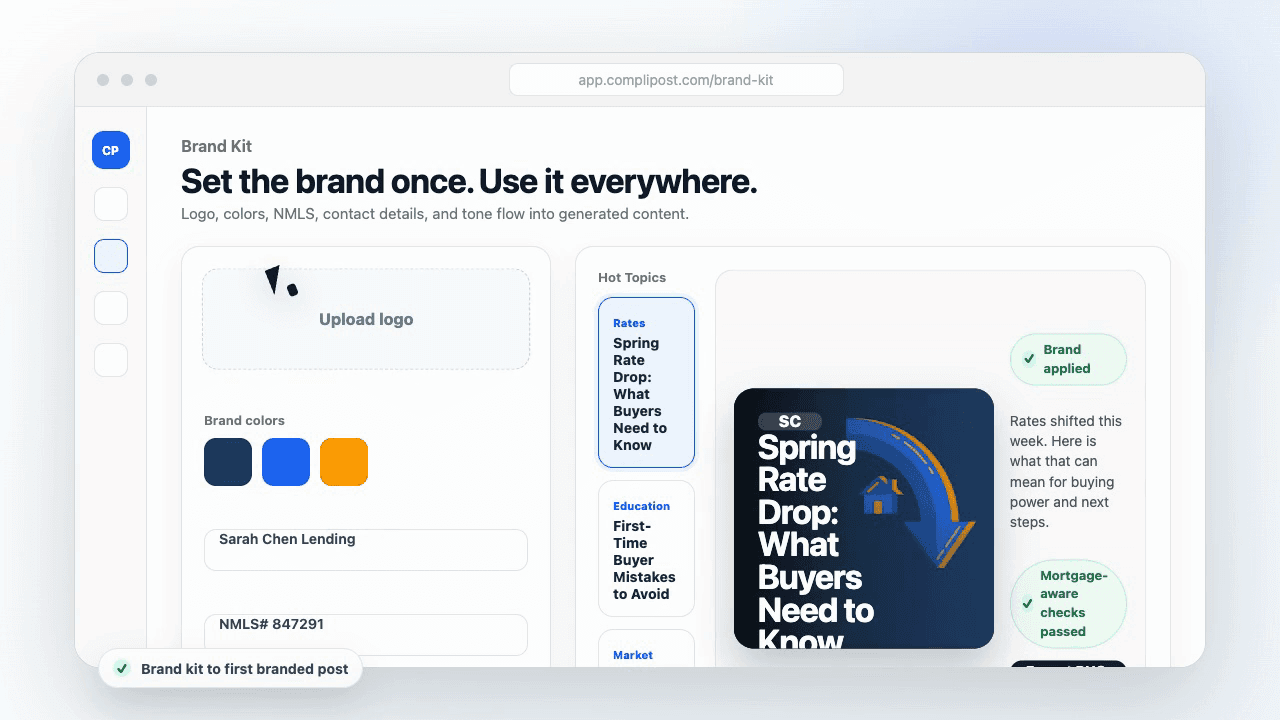
Product workflow
From blank page to export-ready mortgage content
- Start with a borrower topic
- Generate copy and a visual direction
- Review, save, and export the finished asset
These previews reflect the core CompliPost workflow: create, review, save, and export assets for use in your own channels.
Workflow comparison
| Content approach | What happens | Why it matters |
|---|---|---|
| Random posting | One-off ideas created when there is spare time | Inconsistent visibility and weak reuse |
| Template-only posting | Faster design but still requires rewriting and review | Helpful starting point, but not a full system |
| CompliPost workflow | Plan, generate, review, save, and export from one place | Better consistency with mortgage-aware review context |
| Done-for-you service | Someone else creates much of the content | Useful for some teams, but less control and less immediate reuse |
Who this guide helps
This guide is for loan officers working on solo loan officers who need a repeatable mortgage content workflow. The goal is to turn a broad mortgage topic into one borrower question, one useful takeaway, and one asset that can be reviewed before it is shared.
- You need content that sounds like a loan officer, not a generic brand account
- You want examples that can become captions, graphics, GIFs, or PDFs
- You need a clear place to review claims before export
- You want finished work saved for reuse, not lost in a chat thread
A practical workflow for this use case
Start with a narrow scenario, then move through planning, drafting, visual creation, review, and export. For attorney retirement home purchase pension income content, that means the topic should be specific enough that a borrower or referral partner can immediately understand what decision the content helps with.
- Choose the borrower type, loan topic, or platform before generating copy
- Draft the caption and visual together so the asset feels cohesive
- Use the federal baseline review aid to flag claims and disclosure gaps
- Export the finished asset and save the post as a reusable starting point
What makes the content stronger
Strong mortgage content is usually specific, plain-spoken, and calm. It explains tradeoffs without pretending one answer fits every borrower. That is especially important on public social channels, where a short post can be interpreted without the full context of a loan conversation.
- Name the borrower question in the first line
- Explain one decision or tradeoff instead of covering everything
- Use examples without implying approval, savings, or rate outcomes
- End with a soft next step, checklist, or guide rather than pressure
Compliance-aware review notes
CompliPost should be treated as a review aid, not a compliance approval system. The public page, generated draft, graphic, and exported asset should all stay honest about that boundary.
- Review specific payment, APR, rate, savings, and qualification language
- Avoid “best,” “lowest,” “guaranteed,” “free,” and urgency claims unless approved
- Check NMLS, Equal Housing, company, and state-specific requirements
- Use company or legal review for anything outside the federal baseline
How this connects to the rest of CompliPost
A focused guide should leave you with a usable next step. After you understand the topic, you can turn it into a calendar slot, a reviewed social post, a downloadable guide, or a platform-specific version for the channel where your audience already spends time.
- Use the content calendar to turn the idea into a weekly plan
- Use the compliance page when claims or disclosures need a slower pass
- Use lead magnets when the topic deserves a deeper PDF guide
- Use platform pages to adapt the same idea for LinkedIn, Facebook, or Instagram
Recommended next steps
Self-employed borrower hub
Create income-documentation education for self-employed borrowers.
Reverse Mortgage Retirement Planning Content
Comprehensive content on reverse mortgages and retirement home financing.
Attorney Mortgage Guide
Full guide for attorney borrowers including later-career scenarios.
Retirement Home Buying Strategy
Broader content on home buying in retirement across professions.
Examples
"Retired federal judge, $5K monthly pension, $3K Social Security, just closed on her retirement home. Here's how."
Case study showing retirement income qualification and home purchase strategy.
"Pension income + Social Security + investment returns = here's how lenders evaluate retirement home buyers."
Educational post explaining retirement income qualification.
"Your pension is stable income. Here's why lenders love lending to retirees."
Perspective piece on the strength of pension-based retirement income.
"Retirement home buying strategy: mortgage vs. reverse mortgage, income planning, and lifestyle."
Comprehensive guide for attorneys buying homes in or near retirement.
FAQ
Can I qualify for a mortgage on just my pension and Social Security income?+
Yes, if the combined income is sufficient and documented. Lenders evaluate pension and Social Security just like employment income. You need: (1) a pension statement showing your monthly payment and confirmation it's lifetime (not limited); (2) a Social Security statement (SS-1099 or letter from Social Security Administration) showing your benefit amount; (3) ideally two years of tax returns showing the income was received; (4) strong credit and assets. If your pension and Social Security combined exceed the mortgage payment you're applying for, you'll likely qualify. The lender just wants proof that the income is stable and will continue for your lifetime.
What if my pension ends when I die (not continuing to my spouse)?+
Lenders typically use your lifetime pension income for qualification regardless of what happens to your spouse afterward. However, if you're married and want the mortgage to be assumable by your spouse after your death, you should discuss that with your attorney. From a pure mortgage qualification perspective, lenders count your pension income based on your lifetime benefit. If you have a non-continuing pension, that's fine; lenders still count it. The mortgage will be an obligation on the estate, so your heirs would either pay it off or refinance after you pass.
Can I use investment income from my portfolio in retirement to qualify?+
Yes. Investment income (dividends, interest, rental income from investment properties) documented through tax returns counts as income. You'll need two years of tax returns showing the investment income. Lenders typically use a conservative approach: if you've shown 2+ years of consistent investment income, they'll count it. Some lenders may discount inconsistent investment income or use a lower percentage if income fluctuates. Bring 60 days of recent brokerage statements showing your assets and income sources. The larger your portfolio and the more consistent the income, the more confidently lenders count it.
What's a reverse mortgage, and how is it different from a traditional mortgage?+
A reverse mortgage (HECM—Home Equity Conversion Mortgage) is a loan for homeowners 62+ that converts home equity into cash. Instead of making monthly payments, the lender pays you (monthly, lump sum, or line of credit). The loan is repaid when you sell the home, move, or pass away (heirs can inherit by repaying or selling). Reverse mortgages are useful if you're 62+ and want to access home equity without monthly payments. Traditional mortgages require monthly payments and are better if you want to build wealth through mortgage paydown. Some later-career attorneys choose reverse mortgages to reduce fixed expenses; others prefer traditional mortgages for wealth building. The choice depends on your situation; discuss both options with your loan officer and financial advisor.
Will buying a house in retirement affect my Social Security benefits?+
No. Home purchases or mortgages don't affect Social Security benefits. Social Security is based on your earnings history and age; it's independent of assets or liabilities. Mortgage payments don't reduce your benefits. However, they do reduce your monthly cash flow, so factor the mortgage payment into your retirement budget. Discuss with your financial advisor to ensure the mortgage payment is comfortable within your retirement income and spending plan. From a Social Security perspective, you're fine; from a lifestyle and budget perspective, make sure the home and mortgage fit your retirement plan.
Create mortgage content with a calmer workflow
CompliPost helps you plan, generate, review, save, and export useful mortgage content without pretending compliance or social distribution is automatic.
Start free