Legal Professional
Social Content for Attorneys Strategizing Market Timing and Interest Rates
Sophisticated attorneys think about macroeconomic conditions, interest rates, and market cycles. Your content for this segment should address the real factors that affect home buying timing and show that attorneys can optimize their purchase strategy around market conditions.
How do interest rates affect my borrowing power and home buying timeline?
Interest rates directly impact affordability. Social content should show the math and help attorneys think strategically.
- Monthly payment impact: 1% rate change = ~$100-200 monthly payment difference per $200K borrowed; substantial over 30 years
- Affordability shift: lower rates allow larger mortgages; higher rates reduce purchasing power
- Timing strategy: buying when rates are low locks in savings; waiting for rate drops is speculative
- Lock-in benefit: fixed-rate mortgages lock your rate for 30 years; refinancing creates costs
- Market cycles: historical low rates create buying urgency; high rate environments shift advantage to sellers
Should I buy now or wait for rates to drop?
Timing is hard. Content should help attorneys think through the decision without fear-mongering.
- No one predicts rates: attempting to time the market often backfires; rates may stay high or go higher
- Home equity build: buying now starts building equity; waiting delays wealth accumulation
- Market conditions: in low-rate environments, competition and prices are high; rate increases reduce competition
- Personal timeline: buying when you're ready (income stable, credit solid, needs clear) often beats rate timing
- Rate-lock option: lock a rate within 60 days of pre-approval; protects you if rates rise during underwriting
What messaging speaks to attorney strategic thinkers?
Attorneys are analytical and appreciate data-driven guidance. Content should be substantive and balanced.
- Show the math: how rate changes affect monthly payments and lifetime costs
- Acknowledge rate uncertainty: no one knows where rates are going; data doesn't predict the future
- Emphasize personal timeline: buying when right for your life matters more than perfect market timing
- Share historical perspective: rates are cyclical; historically low rates were temporary; buying on a cycle means timing always feels imperfect
- Position yourself as the advisor who helps think through timing without creating artificial urgency
How do you help attorneys think strategically about buying timing?
Export content that helps attorneys make informed decisions. This is where you add real value.
- Create content on interest rate cycles and historical perspective
- Develop calculators: monthly payment at different rates, lifetime cost comparison
- Build email sequences: help attorneys think through timing and strategy
- Offer a strategic consultation: analyze rates, timeline, and borrowing power
- Export content as downloadable market analysis and timing frameworks
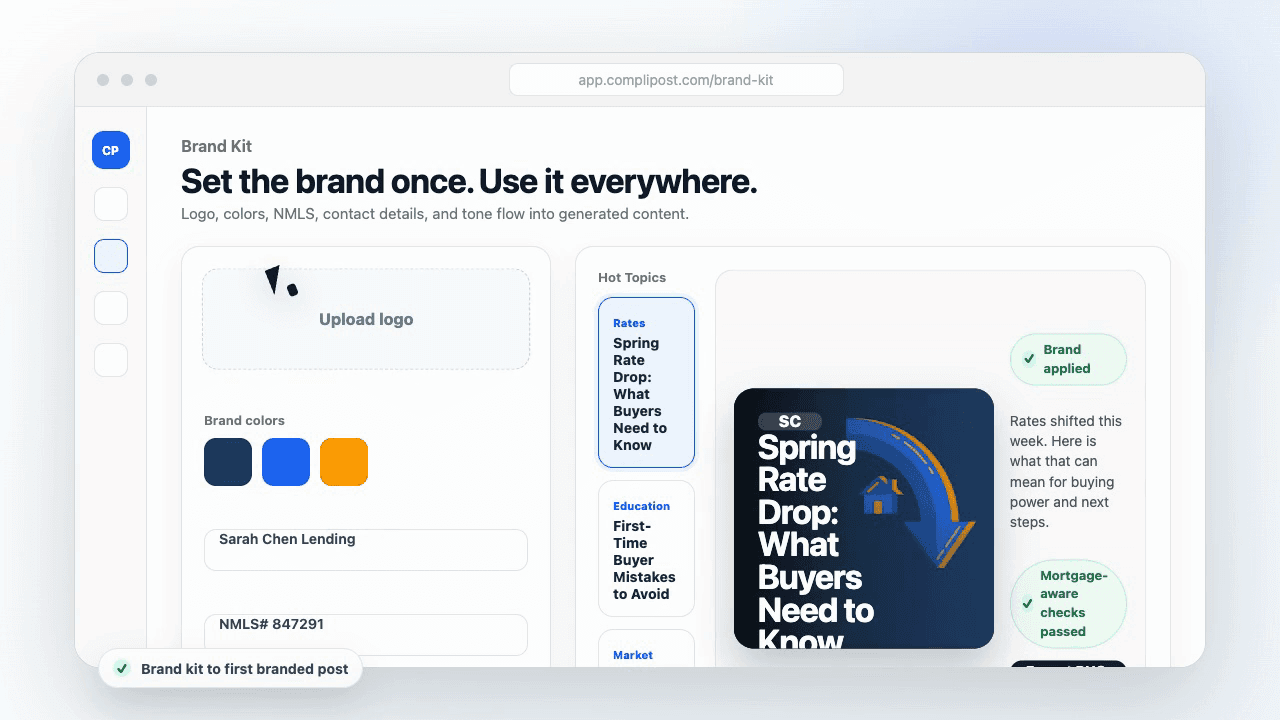
Product workflow
From blank page to export-ready mortgage content
- Start with a borrower topic
- Generate copy and a visual direction
- Review, save, and export the finished asset
These previews reflect the core CompliPost workflow: create, review, save, and export assets for use in your own channels.
Workflow comparison
| Content approach | What happens | Why it matters |
|---|---|---|
| Random posting | One-off ideas created when there is spare time | Inconsistent visibility and weak reuse |
| Template-only posting | Faster design but still requires rewriting and review | Helpful starting point, but not a full system |
| CompliPost workflow | Plan, generate, review, save, and export from one place | Better consistency with mortgage-aware review context |
| Done-for-you service | Someone else creates much of the content | Useful for some teams, but less control and less immediate reuse |
Who this guide helps
This guide is for loan officers working on solo loan officers who need a repeatable mortgage content workflow. The goal is to turn a broad mortgage topic into one borrower question, one useful takeaway, and one asset that can be reviewed before it is shared.
- You need content that sounds like a loan officer, not a generic brand account
- You want examples that can become captions, graphics, GIFs, or PDFs
- You need a clear place to review claims before export
- You want finished work saved for reuse, not lost in a chat thread
A practical workflow for this use case
Start with a narrow scenario, then move through planning, drafting, visual creation, review, and export. For attorney interest rate market timing mortgage strategy content, that means the topic should be specific enough that a borrower or referral partner can immediately understand what decision the content helps with.
- Choose the borrower type, loan topic, or platform before generating copy
- Draft the caption and visual together so the asset feels cohesive
- Use the federal baseline review aid to flag claims and disclosure gaps
- Export the finished asset and save the post as a reusable starting point
What makes the content stronger
Strong mortgage content is usually specific, plain-spoken, and calm. It explains tradeoffs without pretending one answer fits every borrower. That is especially important on public social channels, where a short post can be interpreted without the full context of a loan conversation.
- Name the borrower question in the first line
- Explain one decision or tradeoff instead of covering everything
- Use examples without implying approval, savings, or rate outcomes
- End with a soft next step, checklist, or guide rather than pressure
Compliance-aware review notes
CompliPost should be treated as a review aid, not a compliance approval system. The public page, generated draft, graphic, and exported asset should all stay honest about that boundary.
- Review specific payment, APR, rate, savings, and qualification language
- Avoid “best,” “lowest,” “guaranteed,” “free,” and urgency claims unless approved
- Check NMLS, Equal Housing, company, and state-specific requirements
- Use company or legal review for anything outside the federal baseline
How this connects to the rest of CompliPost
A focused guide should leave you with a usable next step. After you understand the topic, you can turn it into a calendar slot, a reviewed social post, a downloadable guide, or a platform-specific version for the channel where your audience already spends time.
- Use the content calendar to turn the idea into a weekly plan
- Use the compliance page when claims or disclosures need a slower pass
- Use lead magnets when the topic deserves a deeper PDF guide
- Use platform pages to adapt the same idea for LinkedIn, Facebook, or Instagram
Recommended next steps
Self-employed borrower hub
Create income-documentation education for self-employed borrowers.
When to Buy Home Timing Strategy
Broader content on home buying timing and market cycles.
Attorney Mortgage Guide
Full guide for attorney borrowers including strategic considerations.
Interest Rate Impact on Mortgage Approval
Content addressing interest rates and approval timelines.
Examples
"Rates dropped 0.5%, attorney could afford $50K more in home. But market shifted—fewer sellers. Here's the tradeoff."
Balanced post showing rate/market relationship and timing complexity.
"Should you buy when rates are high? Here's the math that matters."
Educational post showing affordability calculations at different rates.
"You can't time the market. Here's what matters in your buying decision."
Perspective piece on moving beyond rate-timing psychology to personal readiness.
"Interest rates are cyclical. Here's what 30 years of rate history tells attorney buyers."
Data-driven post on rate cycles and long-term thinking.
FAQ
If I think rates will drop, should I wait to buy?+
Maybe, maybe not—no one reliably predicts rates. Historically, waiting for rate drops has caused buyers to miss opportunities. Rates may drop, but in low-rate environments, prices and competition are high (sellers still get bids). When rates rise, competition falls but you've waited 6-12 months without building equity. The safe approach: buy when you're ready (income stable, credit solid, needs clear) rather than speculating on rates. If you must wait for a rate drop, set a specific trigger: 'If rates hit X%, I'll buy.' Otherwise, you risk endless waiting. Discuss with your loan officer; they'll help you think through the timing strategically.
How much does a 0.5% rate change affect my monthly payment?+
Roughly $100-200 per $200K borrowed on a 30-year mortgage. If you're borrowing $400K: 0.5% rate change = approximately $200-400 monthly difference. That's $2,400-4,800 per year. Over 30 years, the total interest difference is substantial. This is why rate environment matters—but it also shows why being pre-approved and ready to move when rates are favorable is important. Get pre-approved so you know your target rate range and can act quickly if rates drop. Your loan officer can show you the exact payment difference for your specific loan amount.
What if rates rise during my mortgage application process?+
That's why rate locks exist. Once you lock a rate (typically within 60 days of pre-approval), it doesn't change even if market rates rise. Your pre-approval letter should specify the locked rate and lock period. If rates rise after you lock, you benefit; if they fall, you're stuck with the locked rate. Some lenders offer rate-lock extensions or adjustments, but locks are binding. Make sure you understand your rate lock terms before locking; ask your loan officer to explain exactly when your lock starts and ends.
Should I refinance if rates drop after I buy?+
Maybe. Refinancing has costs (appraisal, processing, title, etc.), typically 2-4% of the loan amount. If rates drop 0.75%+ below your current rate, refinancing may break even and benefit you long-term. If the drop is 0.5%, the decision is marginal; you'd need to stay in the home a while to recover costs. Your loan officer can calculate the break-even point and help you decide. Generally, significant rate drops (1%+) strongly favor refinancing; minor drops (0.25%) don't usually justify the costs.
How does my attorney's income affect rate and timing strategy?+
Your income stability and professional reputation can influence your negotiating position with lenders. Attorney borrowers are typically low-risk and may receive better rates than average borrowers. Use this: lock in favorable rates when available; don't wait for perfect timing that may not come. If you're early in your career or experiencing income volatility, locking a rate when you're pre-approved is especially smart—interest rate protection against further uncertainty. Discuss rate timing with your loan officer; they'll help you balance rate opportunism with personal readiness.
Create mortgage content with a calmer workflow
CompliPost helps you plan, generate, review, save, and export useful mortgage content without pretending compliance or social distribution is automatic.
Start free