Legal Professional
Social Content Strategy for Law Partners Buying Investment Properties and Luxury Homes
Law firm partners operate in a different financial world. Their income is variable, their assets are often complex, and they frequently consider second homes or investment properties. Your marketing to this segment should address net worth, portfolio strategy, and tax-efficient real estate moves. This is where you position yourself as a lender who understands partnership structures, income distribution, and wealth-building strategy.
What distinguishes a partner's mortgage needs from an associate's?
Partners have volatile income, potential side business interests, and often more sophisticated asset pictures. Their mortgage conversations involve tax strategy, cash flow optimization, and portfolio balance. Social content aimed at partners should acknowledge complexity without creating fear—this audience appreciates intellectual rigor and candid analysis.
- Income is variable: partnership distributions, draws, and bonuses fluctuate; show how lenders model this
- Assets are often layered: retirement accounts, investment accounts, real estate holdings, business equity
- Tax strategy matters: interest deductions on rental properties, principal residence elections, income timing
- Risk tolerance is higher: partners often explore second homes, investment rentals, or development opportunities
- Decision-making is faster: partners know what they want and move quickly once the right loan is presented
How do you address jumbo loans and portfolio lending for attorney clients?
Not all partners qualify for conventional conforming mortgages. Jumbo loans, portfolio products, and non-standard income documentation are tools your marketing should mention. Content showing that you understand alternative loan products—and that you can navigate them—positions you as the expert partners seek out.
- Jumbo loans: highlight that partnership income, even if variable, can support large mortgages with the right lender
- Portfolio loans: mention programs designed for complex income profiles and professional borrowers
- Investment property financing: show how DSCR loans or portfolio products work for attorney-investors
- Asset-based lending: address programs that look beyond income to total net worth for high-net-worth borrowers
- Refinance strategies: discuss cash-out refis, rate-and-term options, and tax-loss harvesting opportunities
What messaging drives engagement with high-net-worth attorney audiences?
Partners respond to content that respects their time and intelligence. Social posts should be concise, data-driven, and focused on actionable strategy. They read LinkedIn heavily, trust referrals from peers, and expect you to have done your homework before the conversation starts.
- LinkedIn: write about macro trends affecting real estate markets, interest rates, and investment strategy
- Email: send market updates and analysis; position yourself as a strategic partner, not a product pusher
- Referral partnerships: cultivate relationships with accountants and tax advisors serving attorneys
- Podcast appearances: seek out legal podcasts and thought leadership platforms where partners congregate
- Private events: host educational sessions at law firms or bar association events; focus on strategy, not sales
How do attorneys planning second homes or investment rentals use this content?
Attorneys interested in second homes or investment properties want content that frames these decisions strategically. Show the tax implications, cash flow models, and financing options. Export content that can be shared with accountants and financial advisors—many of your borrowers run decisions by their tax teams.
- Create downloadable guides on second home strategies and tax implications
- Build content around regional markets with strong attorney demographics (coastal markets, tech hubs, resort areas)
- Develop email sequences for attorneys considering portfolio expansion or wealth diversification
- Partner with property managers and investment advisors to cross-refer attorney clients
- Export content as white papers or PDFs for law firm educational events
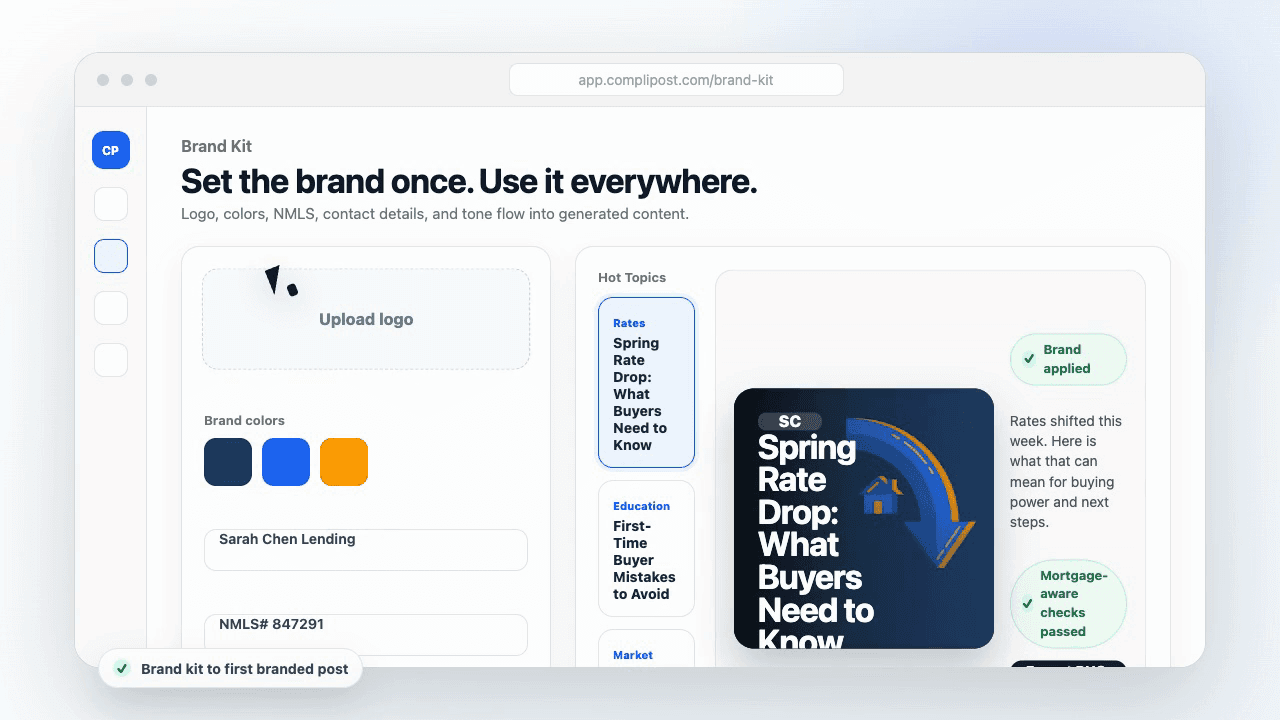
Product workflow
From blank page to export-ready mortgage content
- Start with a borrower topic
- Generate copy and a visual direction
- Review, save, and export the finished asset
These previews reflect the core CompliPost workflow: create, review, save, and export assets for use in your own channels.
Workflow comparison
| Content approach | What happens | Why it matters |
|---|---|---|
| Random posting | One-off ideas created when there is spare time | Inconsistent visibility and weak reuse |
| Template-only posting | Faster design but still requires rewriting and review | Helpful starting point, but not a full system |
| CompliPost workflow | Plan, generate, review, save, and export from one place | Better consistency with mortgage-aware review context |
| Done-for-you service | Someone else creates much of the content | Useful for some teams, but less control and less immediate reuse |
Who this guide helps
This guide is for loan officers working on solo loan officers who need a repeatable mortgage content workflow. The goal is to turn a broad mortgage topic into one borrower question, one useful takeaway, and one asset that can be reviewed before it is shared.
- You need content that sounds like a loan officer, not a generic brand account
- You want examples that can become captions, graphics, GIFs, or PDFs
- You need a clear place to review claims before export
- You want finished work saved for reuse, not lost in a chat thread
A practical workflow for this use case
Start with a narrow scenario, then move through planning, drafting, visual creation, review, and export. For attorney partner luxury home investment property content, that means the topic should be specific enough that a borrower or referral partner can immediately understand what decision the content helps with.
- Choose the borrower type, loan topic, or platform before generating copy
- Draft the caption and visual together so the asset feels cohesive
- Use the federal baseline review aid to flag claims and disclosure gaps
- Export the finished asset and save the post as a reusable starting point
What makes the content stronger
Strong mortgage content is usually specific, plain-spoken, and calm. It explains tradeoffs without pretending one answer fits every borrower. That is especially important on public social channels, where a short post can be interpreted without the full context of a loan conversation.
- Name the borrower question in the first line
- Explain one decision or tradeoff instead of covering everything
- Use examples without implying approval, savings, or rate outcomes
- End with a soft next step, checklist, or guide rather than pressure
Compliance-aware review notes
CompliPost should be treated as a review aid, not a compliance approval system. The public page, generated draft, graphic, and exported asset should all stay honest about that boundary.
- Review specific payment, APR, rate, savings, and qualification language
- Avoid “best,” “lowest,” “guaranteed,” “free,” and urgency claims unless approved
- Check NMLS, Equal Housing, company, and state-specific requirements
- Use company or legal review for anything outside the federal baseline
How this connects to the rest of CompliPost
A focused guide should leave you with a usable next step. After you understand the topic, you can turn it into a calendar slot, a reviewed social post, a downloadable guide, or a platform-specific version for the channel where your audience already spends time.
- Use the content calendar to turn the idea into a weekly plan
- Use the compliance page when claims or disclosures need a slower pass
- Use lead magnets when the topic deserves a deeper PDF guide
- Use platform pages to adapt the same idea for LinkedIn, Facebook, or Instagram
Recommended next steps
Self-employed borrower hub
Create income-documentation education for self-employed borrowers.
Attorney Mortgage Guide
Full guide to mortgage strategies for attorneys across career stages, from associates to partners.
Jumbo Loan Specialist Marketing
Social content strategies for lenders specializing in high-net-worth borrowers and jumbo mortgages.
Investment Property Mortgage Content
Content addressing investor-focused financing, rental property strategies, and portfolio expansion.
Examples
"Three law partners, three strategies: primary residence jumbo, investment rental with DSCR, portfolio second home. Here's what each loan looked like."
Write as a detailed LinkedIn post or case study; show the income analysis and loan structure for each scenario.
"Your partnership income is variable—and that's why traditional underwriting fails. Here's how portfolio lenders evaluate attorney borrowers."
Create an educational video or carousel explaining how non-traditional underwriting works for self-employed and partnership income.
"Thinking about a second home? Tax strategy matters more than you think. Here's what to tell your accountant before you apply."
Email this as a checklist or downloadable PDF; position yourself as a strategic advisor who coordinates with tax professionals.
"Investment property strategy for attorneys: jumbo mortgages, portfolio loans, and tax-loss harvesting in real estate."
Post as a long-form LinkedIn article or thought leadership piece aimed at attorney investors and financial planners.
FAQ
How do lenders evaluate partnership income for mortgage qualification?+
Partnership income is evaluated using two years of tax returns showing your K-1 distributions or guaranteed payments. Lenders typically average the income over the two years, though some will use the most recent year if it's higher. If you're a newer partner (less than two years), your partnership agreement can help—some lenders will use the guaranteed payment or projected distribution from the agreement. Volatility is expected; lenders account for it. Bring your K-1s and partnership agreement to your pre-approval meeting; a loan officer experienced with attorney borrowers will know how to present your income most favorably.
Can I use side business income or consulting work to qualify for a larger mortgage?+
Yes, if you have at least two years of documented income from the side work. Most lenders require two years of tax returns showing the income before they'll count it toward qualification. If you're a newer partner doing consulting or expert witness work, that's a candidate for additional income—as long as you have tax documentation. Bring all 1099s and Schedule C forms to your loan officer. They'll evaluate which income can be counted and may apply conservative underwriting to newer income streams, but the income counts toward your overall borrowing power.
What's the difference between a jumbo loan and a portfolio loan for attorney borrowers?+
Jumbo loans are mortgages larger than conforming limits (typically $766K+, varying by market). Portfolio loans are held by the lender rather than sold on the secondary market, giving the lender flexibility to underwrite complex income profiles. As an attorney partner, you may qualify for either. Jumbo loans often have competitive rates but stricter income documentation. Portfolio loans may offer more flexibility on income verification but sometimes carry higher rates. Your loan officer will evaluate which option gives you the best terms. Some lenders offer both, which means you get to compare.
How do tax implications affect my second home or investment property strategy?+
This is where you absolutely coordinate with your accountant. Second homes (not primary residences) may have different mortgage interest deduction rules. Investment properties are subject to passive activity rules and potential loss limitations. Real estate professionals can deduct rental losses if they meet IRS criteria. Your accountant and loan officer need to be aligned: the mortgage strategy should match your tax strategy. Before you apply, schedule a three-way conversation with your accountant, your financial advisor, and your loan officer. A coordinated approach saves tens of thousands in taxes over time.
What credit and asset documentation do portfolio lenders require from attorney borrowers?+
Portfolio lenders typically require the same credit documentation as traditional lenders (credit report, verification of employment, asset verification), but they may ask for additional context given the complexity of attorney income. They want to see bank statements, investment account statements, and your partnership agreement. Some may ask for business financial statements if you have a significant business outside the law firm. The underwriting is more thorough but also more nuanced—they're evaluating your *entire* financial picture, not just your mortgage-income ratio. Transparency and organization speed this up significantly. Bring everything organized to your application meeting.
Create mortgage content with a calmer workflow
CompliPost helps you plan, generate, review, save, and export useful mortgage content without pretending compliance or social distribution is automatic.
Start free