Legal Professional
Social Content for Attorneys Investing in Real Estate
Many attorneys view real estate investment as part of wealth-building strategy. Whether it's a second home, a rental property, or a planned portfolio, attorneys need guidance on financing, tax strategy, and risk. Your content for this segment should address the strategic and financial dimensions of real estate investing for high-income professionals.
Why are attorneys interested in rental properties and second homes?
Attorneys are sophisticated investors and often see real estate as a diversification and wealth-building tool. Social content should acknowledge this strategy and position you as a lender who understands it.
- Wealth building: real estate appreciation and leverage appeal to high-income professionals
- Diversification: attorneys diversify away from human capital (law practice income) into real estate
- Tax strategy: rental property deductions and principal residence elections have tax benefits
- Second homes: vacation homes, market relocation homes, or family legacy properties are common among attorneys
- Legacy planning: real estate is a tangible asset to pass to heirs; it fits into comprehensive wealth planning
How do lenders evaluate rental properties for attorney borrowers?
Rental property financing is more complex than primary residence lending. Content should explain the evaluation process and show that well-documented properties are financeable.
- Income qualification: lenders use rental income from the property, but typically at 75% of expected rent after expenses
- Debt-to-income impact: the mortgage payment counts toward DTI; any existing rental properties' mortgages also count
- Down payment: rental properties typically require 20-25% down (more than owner-occupied)
- Appraisal and inspection: rental properties are evaluated for investment viability, not just market value
- Proof of attorney income: your primary income (law practice) must support your primary residence and the investment property
What messaging appeals to attorney-investors?
Attorney-investors are analytical, tax-conscious, and strategic. Content should be substantive, numbers-driven, and acknowledge the complexity of the decisions they're making.
- Frame real estate as strategic wealth-building aligned with attorney financial planning
- Share examples of attorney-investors with multiple properties and diversified portfolios
- Address tax strategy: coordinate with CPAs on property structuring and deduction optimization
- Highlight risk management: insurance, property management, and due diligence reduce investment risk
- Position yourself as a strategic partner who understands attorney-investor goals
How do you help attorney-investors plan multi-property strategies?
Export content that guides attorney-investors through the financing, tax, and strategic dimensions of real estate investing. This is where you add strategic value beyond mortgage mechanics.
- Create content on primary residence plus investment property financing; show the DTI implications
- Develop strategy guides: 1031 exchanges, cost segregation, bonus depreciation for attorneys
- Build email sequences that guide attorneys through acquisition timelines and financing planning
- Partner with tax advisors and investment consultants; cross-refer and build joint content
- Export content as downloadable guides and calculators for investment property analysis
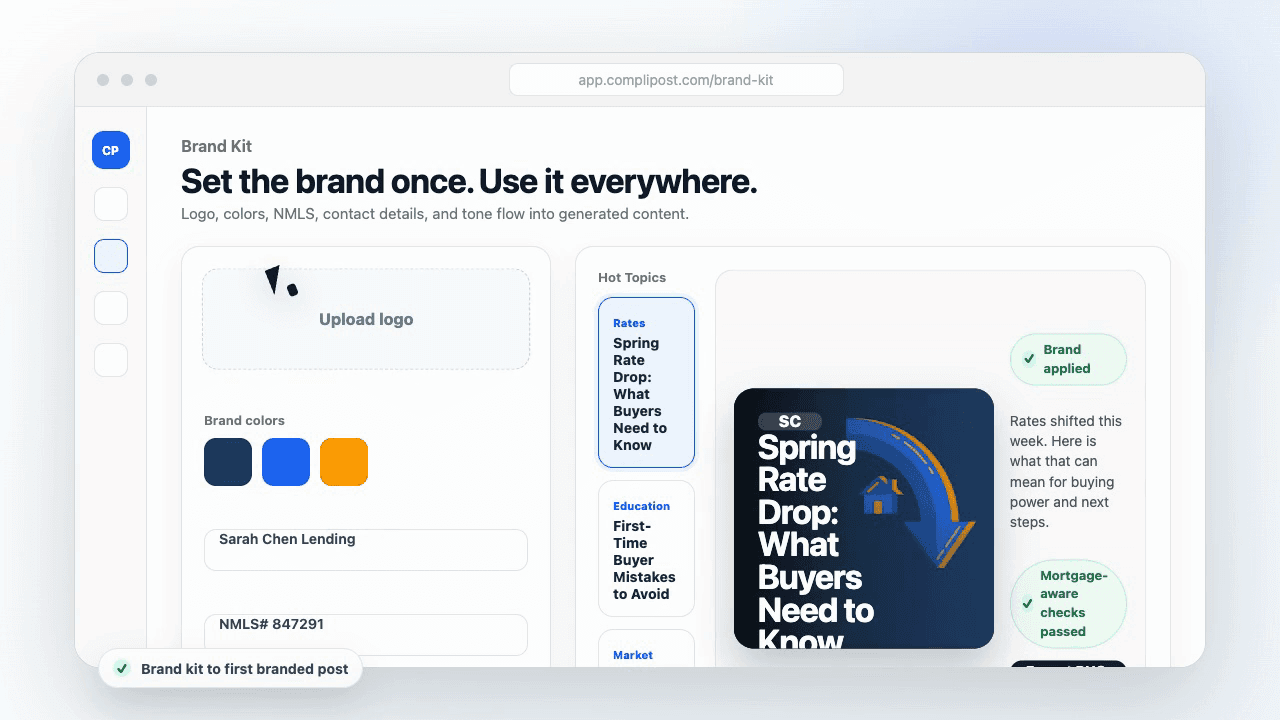
Product workflow
From blank page to export-ready mortgage content
- Start with a borrower topic
- Generate copy and a visual direction
- Review, save, and export the finished asset
These previews reflect the core CompliPost workflow: create, review, save, and export assets for use in your own channels.
Workflow comparison
| Content approach | What happens | Why it matters |
|---|---|---|
| Random posting | One-off ideas created when there is spare time | Inconsistent visibility and weak reuse |
| Template-only posting | Faster design but still requires rewriting and review | Helpful starting point, but not a full system |
| CompliPost workflow | Plan, generate, review, save, and export from one place | Better consistency with mortgage-aware review context |
| Done-for-you service | Someone else creates much of the content | Useful for some teams, but less control and less immediate reuse |
Who this guide helps
This guide is for loan officers working on solo loan officers who need a repeatable mortgage content workflow. The goal is to turn a broad mortgage topic into one borrower question, one useful takeaway, and one asset that can be reviewed before it is shared.
- You need content that sounds like a loan officer, not a generic brand account
- You want examples that can become captions, graphics, GIFs, or PDFs
- You need a clear place to review claims before export
- You want finished work saved for reuse, not lost in a chat thread
A practical workflow for this use case
Start with a narrow scenario, then move through planning, drafting, visual creation, review, and export. For attorney investment property rental real estate mortgage content, that means the topic should be specific enough that a borrower or referral partner can immediately understand what decision the content helps with.
- Choose the borrower type, loan topic, or platform before generating copy
- Draft the caption and visual together so the asset feels cohesive
- Use the federal baseline review aid to flag claims and disclosure gaps
- Export the finished asset and save the post as a reusable starting point
What makes the content stronger
Strong mortgage content is usually specific, plain-spoken, and calm. It explains tradeoffs without pretending one answer fits every borrower. That is especially important on public social channels, where a short post can be interpreted without the full context of a loan conversation.
- Name the borrower question in the first line
- Explain one decision or tradeoff instead of covering everything
- Use examples without implying approval, savings, or rate outcomes
- End with a soft next step, checklist, or guide rather than pressure
Compliance-aware review notes
CompliPost should be treated as a review aid, not a compliance approval system. The public page, generated draft, graphic, and exported asset should all stay honest about that boundary.
- Review specific payment, APR, rate, savings, and qualification language
- Avoid “best,” “lowest,” “guaranteed,” “free,” and urgency claims unless approved
- Check NMLS, Equal Housing, company, and state-specific requirements
- Use company or legal review for anything outside the federal baseline
How this connects to the rest of CompliPost
A focused guide should leave you with a usable next step. After you understand the topic, you can turn it into a calendar slot, a reviewed social post, a downloadable guide, or a platform-specific version for the channel where your audience already spends time.
- Use the content calendar to turn the idea into a weekly plan
- Use the compliance page when claims or disclosures need a slower pass
- Use lead magnets when the topic deserves a deeper PDF guide
- Use platform pages to adapt the same idea for LinkedIn, Facebook, or Instagram
Recommended next steps
Self-employed borrower hub
Create income-documentation education for self-employed borrowers.
Attorney Mortgage Guide
Comprehensive guide covering attorney borrowers and investment strategies.
Investment Property Mortgage Content
Broader content on rental property financing and investor strategies.
Real Estate Investor Loan Officer Niche
Content strategy for lenders specializing in investment property financing.
Examples
"Attorney with primary home mortgage closed on a rental property the same month. Here's how she structured the financing."
Share as a case study showing multi-property strategy and qualification.
"Should attorneys invest in real estate? Tax implications and financing strategies explained."
Write as a comprehensive guide addressing the attorney-investor decision framework.
"Second home + primary residence mortgage: DTI strategy for attorneys building a real estate portfolio."
Create an educational post on managing multiple property mortgages and DTI.
"Investment property financing for attorneys: income documentation, down payments, and strategy."
Write as a detailed breakdown of rental property financing specific to professional borrowers.
FAQ
Can I finance an investment property while I still have a mortgage on my primary residence?+
Yes, absolutely. Lenders evaluate your total debt picture. Both mortgages count toward your DTI. If your primary residence mortgage is $2,000/month and you're applying for a $1,500/month investment property mortgage, your total housing debt is $3,500/month. Lenders will evaluate whether this fits within acceptable DTI ratios given your income. As an attorney, if you have sufficient income and strong credit, lenders will work with you. However, qualifying for two mortgages simultaneously is tighter than qualifying for one; you may need a larger income or a smaller investment property mortgage. Talk to your loan officer about structuring; they may recommend applying for mortgages at different times or in a specific sequence for optimal qualification.
How do lenders evaluate the income potential of a rental property?+
Lenders use DSCR (Debt Service Coverage Ratio) analysis for investment properties. They typically apply a 75% occupancy assumption to market rent (showing cautious income projection) and subtract typical property expenses (taxes, insurance, maintenance, property management—usually ~25-30% of rent). The net income must be sufficient to cover the mortgage payment with some cushion. If you're buying a property with existing tenants and leases, lenders will use the actual rent or market rent (whichever is lower). If the property is vacant, they use market rent with the occupancy haircut. You can improve cash flow assumptions by showing strong tenant demand, below-market property management expenses, or value-add improvements. Some lenders offer "no-ratio" rental programs that evaluate your overall income rather than rental income; these are useful if the property's income is marginal.
What down payment do I need for an investment property?+
Typically 20-25% down payment, compared to 3-5% for primary residences. Some lenders accept 15% down if you have strong credit and reserves. Portfolio lenders may be flexible. The higher down payment requirement reflects the higher risk of investment properties (absentee ownership, market cyclicality, etc.). If you're an attorney with strong income and reserves, some lenders may be more flexible; ask about specific down payment requirements. Also, bringing a larger down payment (25%+) improves your qualification and may get you better rates, as lenders see your commitment to the property.
Do I need to show proof of real estate investment experience before qualifying for an investment property mortgage?+
No, but it helps. Some lenders prefer borrowers with prior real estate investment experience; others don't. If you're a first-time investor, highlighting your professional background (you're an attorney, so you're analytical and detail-oriented), your financial stability, and your reserves can offset lack of investment experience. Working with a real estate agent and property manager who can vouch for your professionalism also helps. If you're buying a stabilized, income-producing property with strong fundamentals, lenders are usually confident. If you're buying a value-add or renovation project, lenders may want to see more experience or require a larger down payment. Be transparent about your investment experience and focus on the property's fundamentals and your income stability.
Can I use projected post-closing income from the rental property to improve qualification?+
No, not immediately. Lenders want to see actual income history from the property. However, once you own the property and have tax returns showing rental income (typically starting year two after purchase), that income can be counted on future refinances or applications. For your initial purchase, you qualify based on your primary income (law practice) and the property evaluation. Once you have tax returns showing actual rental income, that income can be factored into future borrowing decisions. Some lenders offer "rent-back" programs for attorneys purchasing properties for investment; these may be more flexible on income qualification. Discuss options with your loan officer; they may have programs designed for investor-borrowers.
Create mortgage content with a calmer workflow
CompliPost helps you plan, generate, review, save, and export useful mortgage content without pretending compliance or social distribution is automatic.
Start free