Legal Professional
Social Media Content for Attorneys Buying Their First Home as Associates
New law associates face a unique challenge: high student debt, modest starting salaries, and the dream of homeownership. Your borrower base includes young attorneys who need guidance on managing law school debt alongside mortgage qualification. By creating content that acknowledges these realities—and positions them as solvable—you build trust with an underserved segment.
What social messages resonate with new attorneys considering purchase?
New associates respond to candid messaging about the path forward. They're researching whether homeownership is possible *despite* student loans, and they need reassurance that loan officers who understand legal income structures exist. Social content that normalizes the conversation—"Yes, your law school debt counts; here's how lenders evaluate it"—cuts through the noise.
- Address debt-to-income math openly; show that legal education is an investment lenders recognize
- Spotlight programs designed for professionals with delayed wealth (physician loans, professional-track mortgages)
- Share real examples of new attorneys who closed while carrying six-figure debt
- Normalize the timeline: qualifying while paying down student loans takes strategy but is achievable
- Frame the loan officer as an advocate who knows legal career income curves
How do you position yourself as the loan officer for legal professionals?
Attorneys choose loan officers who speak their language and understand their financial picture. Social content that demonstrates knowledge of legal career stages, bar exam timing, and associate compensation builds credibility. You're not just a lender; you're someone who has helped other attorneys navigate this milestone.
- Mention bar exam timing and its impact on application approval windows
- Reference partnership tracks and how projected income affects qualification
- Acknowledge state bar rules on side income and how that factors into lending decisions
- Share case studies of attorneys at different career stages: associates, counsel, partners
- Use terminology that shows domain expertise without being pretentious
What content angles drive engagement with attorney audiences on each platform?
Legal professionals are active on LinkedIn, consume educational content, and respond to substantive posts. Your social strategy should match the platform's tone and the audience's preference for depth. LinkedIn rewards long-form thought leadership; Instagram works if you keep messaging authentic and relatable.
- LinkedIn: write about legal career economics and mortgage qualification; position yourself as a strategic partner
- Instagram/TikTok: share behind-the-scenes stories of attorney clients closing on homes; use humor sparingly
- Email: send educational breakdowns of how student loans affect DTI; attorneys appreciate clear analysis
- Facebook: highlight community ties and local attorney networks you've built relationships with
- Create a one-pager for bar associations or continuing education events
How do you export and use this content as an attorney specialist?
Build a content calendar around attorney hiring seasons, bar exam windows, and partnership announcements. Reuse content across platforms with platform-specific framing. Save templates for emails to local law firms offering educational webinars on mortgages and financial planning for attorneys.
- Batch-create content monthly; schedule around bar exam results and associate hiring cycles
- Create LinkedIn post versions and email versions of the same core message
- Build partnerships with bar associations to position yourself as an expert resource
- Repurpose FAQs into educational PDFs for law firm referrals
- Keep a swipe file of attorney-friendly language that builds trust over time
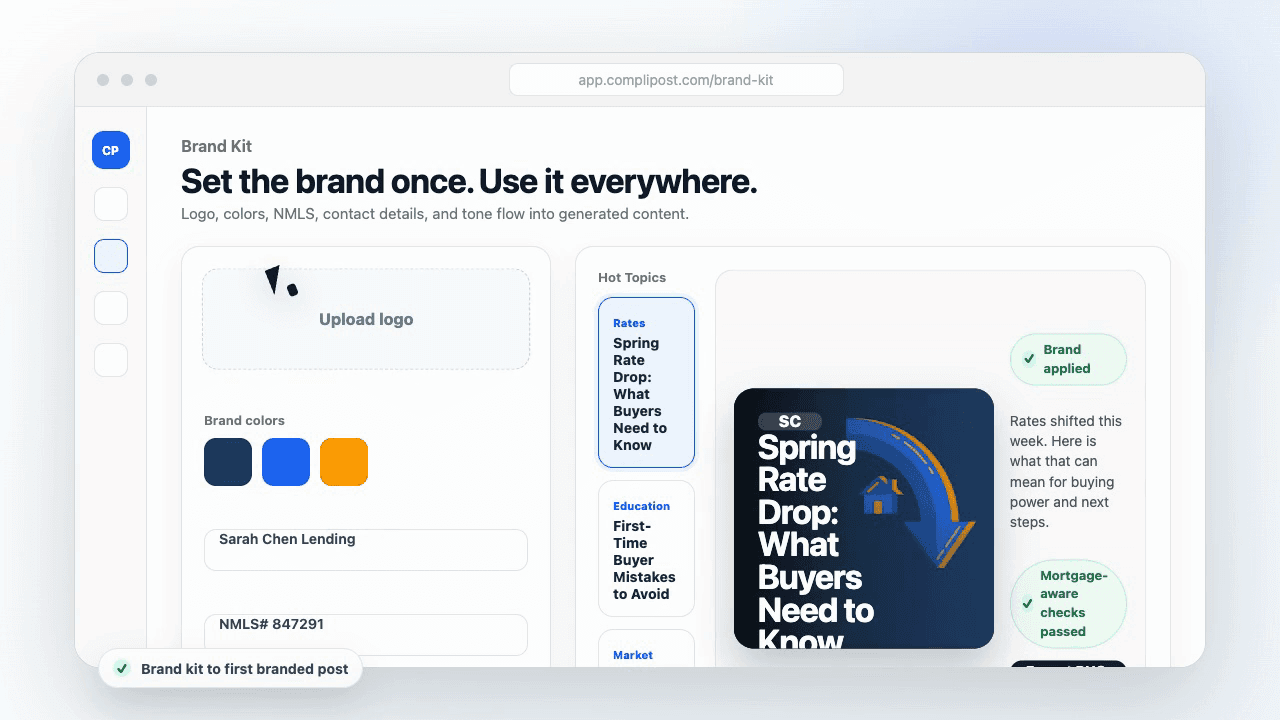
Product workflow
From blank page to export-ready mortgage content
- Start with a borrower topic
- Generate copy and a visual direction
- Review, save, and export the finished asset
These previews reflect the core CompliPost workflow: create, review, save, and export assets for use in your own channels.
Workflow comparison
| Content approach | What happens | Why it matters |
|---|---|---|
| Random posting | One-off ideas created when there is spare time | Inconsistent visibility and weak reuse |
| Template-only posting | Faster design but still requires rewriting and review | Helpful starting point, but not a full system |
| CompliPost workflow | Plan, generate, review, save, and export from one place | Better consistency with mortgage-aware review context |
| Done-for-you service | Someone else creates much of the content | Useful for some teams, but less control and less immediate reuse |
Who this guide helps
This guide is for loan officers working on solo loan officers who need a repeatable mortgage content workflow. The goal is to turn a broad mortgage topic into one borrower question, one useful takeaway, and one asset that can be reviewed before it is shared.
- You need content that sounds like a loan officer, not a generic brand account
- You want examples that can become captions, graphics, GIFs, or PDFs
- You need a clear place to review claims before export
- You want finished work saved for reuse, not lost in a chat thread
A practical workflow for this use case
Start with a narrow scenario, then move through planning, drafting, visual creation, review, and export. For attorney first-time homebuyer content, that means the topic should be specific enough that a borrower or referral partner can immediately understand what decision the content helps with.
- Choose the borrower type, loan topic, or platform before generating copy
- Draft the caption and visual together so the asset feels cohesive
- Use the federal baseline review aid to flag claims and disclosure gaps
- Export the finished asset and save the post as a reusable starting point
What makes the content stronger
Strong mortgage content is usually specific, plain-spoken, and calm. It explains tradeoffs without pretending one answer fits every borrower. That is especially important on public social channels, where a short post can be interpreted without the full context of a loan conversation.
- Name the borrower question in the first line
- Explain one decision or tradeoff instead of covering everything
- Use examples without implying approval, savings, or rate outcomes
- End with a soft next step, checklist, or guide rather than pressure
Compliance-aware review notes
CompliPost should be treated as a review aid, not a compliance approval system. The public page, generated draft, graphic, and exported asset should all stay honest about that boundary.
- Review specific payment, APR, rate, savings, and qualification language
- Avoid “best,” “lowest,” “guaranteed,” “free,” and urgency claims unless approved
- Check NMLS, Equal Housing, company, and state-specific requirements
- Use company or legal review for anything outside the federal baseline
How this connects to the rest of CompliPost
A focused guide should leave you with a usable next step. After you understand the topic, you can turn it into a calendar slot, a reviewed social post, a downloadable guide, or a platform-specific version for the channel where your audience already spends time.
- Use the content calendar to turn the idea into a weekly plan
- Use the compliance page when claims or disclosures need a slower pass
- Use lead magnets when the topic deserves a deeper PDF guide
- Use platform pages to adapt the same idea for LinkedIn, Facebook, or Instagram
Recommended next steps
Self-employed borrower hub
Create income-documentation education for self-employed borrowers.
Attorney Mortgage Guide
Comprehensive guide to mortgage options and financial planning strategies for attorney borrowers at all career stages.
Self-Employed Mortgage Content
Social content ideas for borrowers with non-traditional income (including attorneys with side practices or consulting).
Student Loan Debt and Mortgage Qualification
Detailed breakdown of how student debt affects DTI and qualification—core content for attorney audiences.
Examples
"I helped a big-law associate with $180K student debt close on her first home. Here's what changed her qualification: she reframed her law degree as future income."
Post this as a LinkedIn article or long-form Facebook story with details on the associate's income curve and DTI strategy.
"Your law school debt isn't a dealbreaker—it's what lenders expect. Here's how to present it."
Share as a carousel or educational reel showing how DTI works when student loan payments are factored in.
"Law firm hiring season? Associates are asking about mortgages. Here's what you need to tell them first."
Create an email template or downloadable guide aimed at law firms and recruiting teams; position yourself as a resource.
"Partner track vs. associate salary: which matters more to mortgage lenders? (Spoiler: both, but here's how.)"
Write as a thoughtful LinkedIn post or short video; show the income-qualification progression for attorneys.
FAQ
Do law school loans hurt my mortgage qualification as much as I think?+
No—and this is where many new attorneys get stuck in anxiety. Student loans affect your debt-to-income ratio, but lenders expect them for attorneys. What matters is how your *income* compares to your total debt. If you have a starting salary of $160K and $180K in student debt, your DTI may look tight, but many loan programs are designed with professional borrowers in mind. The key is being honest about your current income (associate salary) and projecting realistically—not assuming you'll make partner-level income in year two. A loan officer experienced with attorney borrowers will present your situation correctly to underwriting.
When should I apply for a mortgage if I just passed the bar exam?+
Timing matters. Most lenders want to see at least 30 days of payment history in your new job, and some want 60 days. If your bar results come out mid-year and you've received an offer, coordinate with your loan officer to apply after you've completed onboarding and your employer has issued a paystub or written offer letter. Don't wait six months hoping to pay down student loans first—the sooner you lock in an interest rate and begin building home equity, the better. Your loan officer can advise on the exact timing based on your jurisdiction's bar exam schedule.
Will signing a partnership track letter help my mortgage application?+
Yes, it can help significantly. A partnership track letter that projects your income growth is more powerful than an associate offer alone. Some lenders will use partnership-track income *if* the offer letter specifies the timeline and compensation. However, use partnership-track income conservatively—lenders may apply a discount to projected income. A letter confirming your associate salary and partnership track is solid; a verbal promise isn't. Bring the offer letter to your pre-approval meeting and let your loan officer decide how to present it to underwriting. Transparency here builds trust.
Does my law degree count toward income qualification in any way?+
Indirectly, yes. Lenders recognize that a law degree is an investment in future earning potential, and they evaluate attorney borrowers based on historical income trends and career progression. If you're a new associate making $160K, that's what counts toward income qualification—not the degree itself. However, if you have any attorney-specific income (side consulting, expert witness work, contract legal services), that may qualify as additional income under certain programs. Disclose everything to your loan officer; they'll know what sticks with underwriting and what doesn't.
Can I use income from a law firm side project or solo work to boost qualification?+
Possibly, but it depends on how established the income is. Most lenders want two years of tax returns showing the income before they'll count it. If you're a new associate just starting a side practice, it won't help *yet*. However, if you're doing contract legal work or expert witness consulting and you have two years of documented income, that counts as self-employment income and can improve your DTI ratio. Bring tax returns and any contracts to your loan officer so they can evaluate it accurately. This is an area where an attorney-savvy lender saves you time and money.
Create mortgage content with a calmer workflow
CompliPost helps you plan, generate, review, save, and export useful mortgage content without pretending compliance or social distribution is automatic.
Start free