Legal Professional
Social Content for Attorneys Using Family Gifts for Down Payment
Many attorneys receive financial help from family for down payments. Gifts from parents, trusts, or family loans have specific documentation requirements. Your content for this segment should explain the rules clearly and show that gift-funded down payments are completely normal and lender-friendly.
What are the rules for using family gifts toward a down payment?
Lenders have clear rules for gift funds. Social content should explain these rules and show that gifts are straightforward when documented properly.
- Gift vs. loan: true gifts are non-repayable; loans must be documented and affect DTI
- Documentation: lender requires a gift letter stating the funds are a true gift, not a loan
- Source documentation: lenders want to verify the gift funds come from a legitimate source (family member bank account, not debt)
- Funds must be seasoned: typically, gift funds must have been in your account for 30-60 days before closing (varies by lender)
- Credit impact: true gifts don't affect your credit; family loans do (they show as debt on your credit report)
How do you document gift funds properly for mortgage underwriting?
Proper documentation prevents delays. Content should guide attorneys through the exact paperwork needed.
- Gift letter: signed by the family member stating the amount, date of gift, and confirmation it's not a loan
- Bank statements: showing the gift funds in the giver's account before transfer and the recipient's account after
- Wire confirmation or check: proof that the gift was actually transferred
- Family member identification: lenders may require ID from the gift-giver for verification
- No repayment agreement: the gift letter must state there's no expectation of repayment
What messaging acknowledges the reality of family financial support?
Many attorneys benefit from family gifts. Content should normalize this without judgment and position you as understanding attorney financial realities.
- Acknowledge that family financial support is common, especially for down payments
- Show that lenders are comfortable with gift-funded down payments when documented
- Share stories of borrowers who used family gifts effectively
- Offer guidance on discussing family gifts with family members (defining terms, protecting relationships)
- Position yourself as the lender who makes gift documentation simple
How do you streamline the gift documentation process?
Export content and templates that make gift documentation simple. This removes barriers and positions you as efficient.
- Create a gift letter template: customize it and share with borrowers
- Develop email sequences that guide borrowers and family members through documentation
- Provide a checklist of what lenders need from gift-givers
- Offer to communicate directly with family members; reduce friction for the borrower
- Export gift documentation templates and guides for downloadable reference
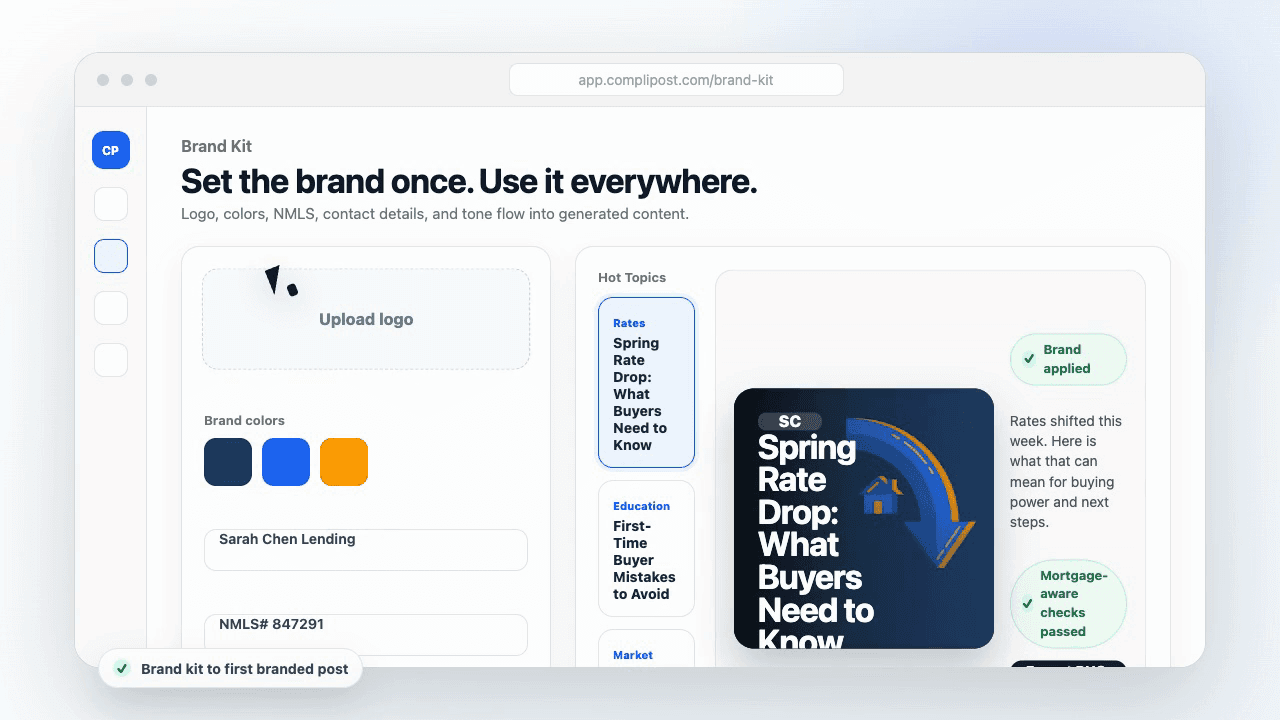
Product workflow
From blank page to export-ready mortgage content
- Start with a borrower topic
- Generate copy and a visual direction
- Review, save, and export the finished asset
These previews reflect the core CompliPost workflow: create, review, save, and export assets for use in your own channels.
Workflow comparison
| Content approach | What happens | Why it matters |
|---|---|---|
| Random posting | One-off ideas created when there is spare time | Inconsistent visibility and weak reuse |
| Template-only posting | Faster design but still requires rewriting and review | Helpful starting point, but not a full system |
| CompliPost workflow | Plan, generate, review, save, and export from one place | Better consistency with mortgage-aware review context |
| Done-for-you service | Someone else creates much of the content | Useful for some teams, but less control and less immediate reuse |
Who this guide helps
This guide is for loan officers working on solo loan officers who need a repeatable mortgage content workflow. The goal is to turn a broad mortgage topic into one borrower question, one useful takeaway, and one asset that can be reviewed before it is shared.
- You need content that sounds like a loan officer, not a generic brand account
- You want examples that can become captions, graphics, GIFs, or PDFs
- You need a clear place to review claims before export
- You want finished work saved for reuse, not lost in a chat thread
A practical workflow for this use case
Start with a narrow scenario, then move through planning, drafting, visual creation, review, and export. For attorney family gift down payment mortgage content, that means the topic should be specific enough that a borrower or referral partner can immediately understand what decision the content helps with.
- Choose the borrower type, loan topic, or platform before generating copy
- Draft the caption and visual together so the asset feels cohesive
- Use the federal baseline review aid to flag claims and disclosure gaps
- Export the finished asset and save the post as a reusable starting point
What makes the content stronger
Strong mortgage content is usually specific, plain-spoken, and calm. It explains tradeoffs without pretending one answer fits every borrower. That is especially important on public social channels, where a short post can be interpreted without the full context of a loan conversation.
- Name the borrower question in the first line
- Explain one decision or tradeoff instead of covering everything
- Use examples without implying approval, savings, or rate outcomes
- End with a soft next step, checklist, or guide rather than pressure
Compliance-aware review notes
CompliPost should be treated as a review aid, not a compliance approval system. The public page, generated draft, graphic, and exported asset should all stay honest about that boundary.
- Review specific payment, APR, rate, savings, and qualification language
- Avoid “best,” “lowest,” “guaranteed,” “free,” and urgency claims unless approved
- Check NMLS, Equal Housing, company, and state-specific requirements
- Use company or legal review for anything outside the federal baseline
How this connects to the rest of CompliPost
A focused guide should leave you with a usable next step. After you understand the topic, you can turn it into a calendar slot, a reviewed social post, a downloadable guide, or a platform-specific version for the channel where your audience already spends time.
- Use the content calendar to turn the idea into a weekly plan
- Use the compliance page when claims or disclosures need a slower pass
- Use lead magnets when the topic deserves a deeper PDF guide
- Use platform pages to adapt the same idea for LinkedIn, Facebook, or Instagram
Recommended next steps
Self-employed borrower hub
Create income-documentation education for self-employed borrowers.
Gift Funds Down Payment
Comprehensive guide to gift fund documentation and qualification with family assistance.
Attorney Mortgage Guide
Full guide for attorney borrowers including down payment strategies.
Down Payment Assistance Programs
Content on various down payment assistance options beyond family gifts.
Examples
"Attorney parent gifting $50K to her child for down payment. Here's the documentation that made it smooth."
Share as a practical case study on gift documentation.
"Family gift for down payment? Here's what lenders need to see (and what they don't want)."
Create an educational post on gift fund documentation rules.
"Gift letter template for attorneys receiving family down payment assistance."
Share a downloadable template that streamlines documentation.
"Gift vs. loan: here's why documentation matters for your mortgage qualification."
Write as a guide explaining the critical difference for lenders.
FAQ
Can I borrow money from my parents for a down payment, or does it have to be a gift?+
Either, but a gift is simpler and doesn't affect your mortgage qualification. If you borrow from family, the loan shows as debt on your credit report and affects your DTI—which may reduce your borrowing power. If your parents truly gift the money (non-repayable), it has no credit impact and doesn't affect DTI. The key difference: intent and documentation. A gift letter clearly states it's a gift with no repayment expectation. A loan agreement documents the loan terms, interest rate, and repayment schedule. If you're genuinely borrowing and plan to repay, document it as a loan and accept the DTI impact. If your parents are truly gifting (a common scenario for down payment help), use a gift letter and enjoy the simplicity. Talk to your parents and loan officer to decide which makes sense.
What if the gift comes from a trust or an inheritance?+
Trust and inheritance gifts work the same way. You'll need documentation showing the gift came from the trust or estate: (1) a gift letter from the trustee or estate executor; (2) trust or estate documentation showing the transfer; (3) bank statements showing the funds were received. Lenders want to verify that the funds are legitimately yours and not contingent on future conditions. Inheritance gifts are straightforward once the estate has distributed funds. Trust distributions may require a trust document or letter from the trustee confirming the distribution. Work with your loan officer; they'll specify what documentation the underwriter needs.
Do gift funds need to be in my bank account for a certain period before closing?+
Yes, typically 30-60 days depending on the lender. Lenders call this "seasoning." The gift funds must be in your account and show on at least two bank statements before you close. This prevents fraud (borrowed money disguised as gifts). If your parents gift you $50K on June 1, you need to have that money in your account through July 1 (or later, depending on your closing date) before lenders will count it. Plan the timing accordingly. Once the funds are seasoned and documented with a gift letter, they're yours to use.
What if my family member can't provide documentation of where the gift funds came from?+
Lenders may require source documentation from the gift-giver's bank or accounts. If the gift is cash or from an account with limited documentation, underwriting gets trickier. Best practice: ask your family member to wire the gift from their bank account (which creates documentation) rather than provide cash. If the gift is already received and you're concerned about documentation, talk to your loan officer. They may request: bank statements from the gift-giver showing the funds were available, proof of assets, or other documentation of the gift source. Large gifts (more than 1-2% of the mortgage amount) sometimes require more scrutiny. Smaller gifts usually move through quickly.
Can I accept a gift from someone other than a family member?+
Depends on the lender. Most lenders require gift funds to come from family members (parents, grandparents, siblings, spouses). Gifts from employers, partners, or friends are viewed more skeptically and may not be allowed. Some lenders allow gifts from anyone if properly documented, but they're cautious about undisclosed loans disguised as gifts. If you're receiving a gift from a non-family member, ask your loan officer upfront. They'll tell you whether it's acceptable and what documentation is needed. When in doubt, stick with family-member gifts; they're always straightforward.
Create mortgage content with a calmer workflow
CompliPost helps you plan, generate, review, save, and export useful mortgage content without pretending compliance or social distribution is automatic.
Start free