Legal Professional
Social Content for Attorneys Building Wealth Through Home Equity
Attorneys often view their primary residence as both a home and a financial asset. Cash-out refinances, home equity loans, and lines of credit are tools for accessing equity while building wealth. Your content for this segment should address the strategy and mechanics of equity access for professional borrowers.
Why do attorneys refinance for cash out?
Attorneys are strategic about wealth building. Social content should address the legitimate reasons for cash-out refinances and show the tax and financial planning implications.
- Consolidation: combining debt at lower mortgage rates than credit card or personal loan rates
- Investment: accessing capital for real estate or other investments without selling appreciated assets
- Liquidity: converting home equity into accessible cash for emergencies or opportunities
- Tax efficiency: mortgage interest may be deductible; personal loan interest typically isn't
- Timing: refinancing when rates are favorable or when you've built sufficient equity
How much equity can an attorney access through refinancing or HELOC?
Home equity is accessible but finite. Content should explain the mechanics of equity access and the limits.
- Typical LTV limits: lenders allow up to 80% LTV (some go 85%) for primary residences; investment properties typically max at 75%
- Equity calculation: (home value - mortgage balance) = equity available; lenders finance up to their LTV limit
- Appraisal: determining current home value; if appreciated, you have more equity to access
- Closing costs: cash-out refis have costs (appraisal, title, processing); factor these into the economics
- Rate comparison: cash-out refis may have slightly higher rates than rate-and-term refis
What messaging helps attorney borrowers think strategically about equity access?
Attorneys respond to content that treats them as strategic planners. Frame equity access as part of comprehensive financial planning.
- Position cash-out refinancing as a financial planning tool, not just debt management
- Share examples of attorneys using equity access for investments or business needs
- Address coordination with CPAs: tax implications of mortgage interest deductions, investment income, etc.
- Highlight liquidity benefits: accessible equity without selling appreciated assets
- Position yourself as the lender who understands attorney financial strategy
How do you help attorneys plan and execute equity access strategies?
Export content that guides attorneys through strategic planning. This is where you position yourself as an advisor.
- Create content on cash-out refi vs. HELOC vs. home equity loan—when each makes sense
- Develop content on tax planning: coordinate with CPAs on deduction optimization
- Build email sequences: help attorneys think through equity access timing and amounts
- Partner with tax advisors and investment consultants; cross-refer and build joint content
- Export content as calculators and guides showing equity access scenarios and outcomes
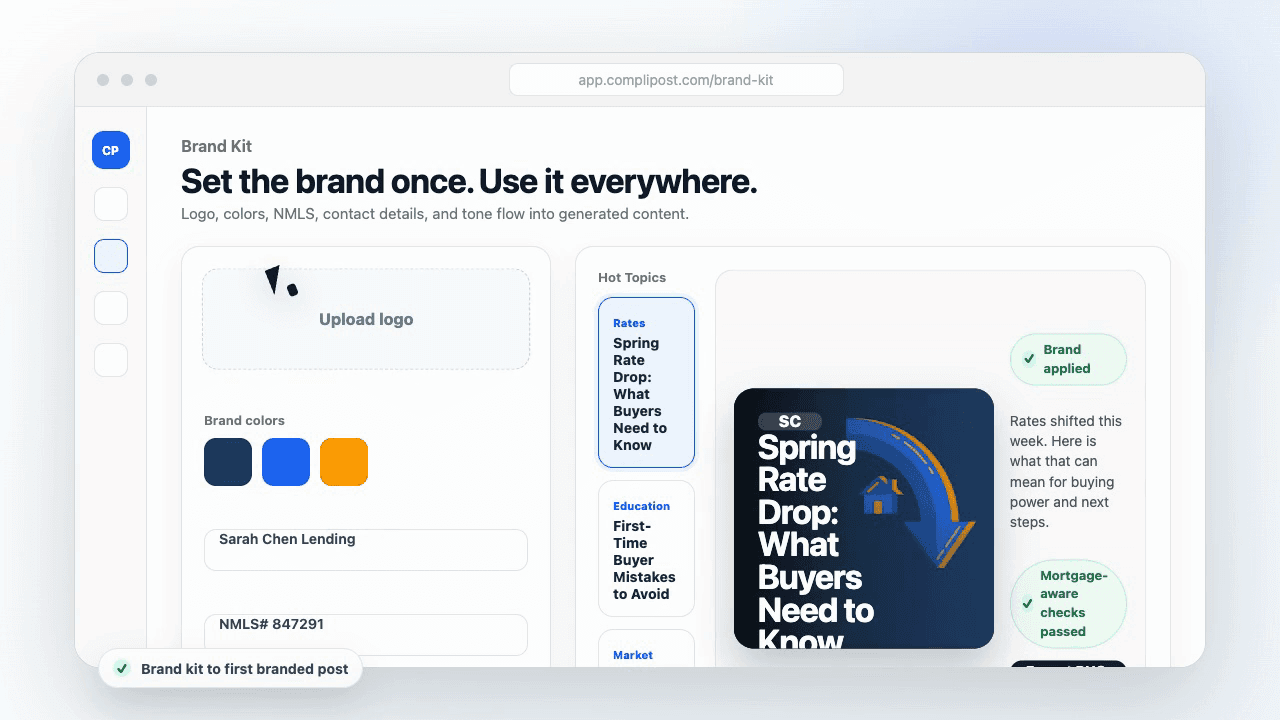
Product workflow
From blank page to export-ready mortgage content
- Start with a borrower topic
- Generate copy and a visual direction
- Review, save, and export the finished asset
These previews reflect the core CompliPost workflow: create, review, save, and export assets for use in your own channels.
Workflow comparison
| Content approach | What happens | Why it matters |
|---|---|---|
| Random posting | One-off ideas created when there is spare time | Inconsistent visibility and weak reuse |
| Template-only posting | Faster design but still requires rewriting and review | Helpful starting point, but not a full system |
| CompliPost workflow | Plan, generate, review, save, and export from one place | Better consistency with mortgage-aware review context |
| Done-for-you service | Someone else creates much of the content | Useful for some teams, but less control and less immediate reuse |
Who this guide helps
This guide is for loan officers working on solo loan officers who need a repeatable mortgage content workflow. The goal is to turn a broad mortgage topic into one borrower question, one useful takeaway, and one asset that can be reviewed before it is shared.
- You need content that sounds like a loan officer, not a generic brand account
- You want examples that can become captions, graphics, GIFs, or PDFs
- You need a clear place to review claims before export
- You want finished work saved for reuse, not lost in a chat thread
A practical workflow for this use case
Start with a narrow scenario, then move through planning, drafting, visual creation, review, and export. For attorney home equity cash-out refinance wealth content, that means the topic should be specific enough that a borrower or referral partner can immediately understand what decision the content helps with.
- Choose the borrower type, loan topic, or platform before generating copy
- Draft the caption and visual together so the asset feels cohesive
- Use the federal baseline review aid to flag claims and disclosure gaps
- Export the finished asset and save the post as a reusable starting point
What makes the content stronger
Strong mortgage content is usually specific, plain-spoken, and calm. It explains tradeoffs without pretending one answer fits every borrower. That is especially important on public social channels, where a short post can be interpreted without the full context of a loan conversation.
- Name the borrower question in the first line
- Explain one decision or tradeoff instead of covering everything
- Use examples without implying approval, savings, or rate outcomes
- End with a soft next step, checklist, or guide rather than pressure
Compliance-aware review notes
CompliPost should be treated as a review aid, not a compliance approval system. The public page, generated draft, graphic, and exported asset should all stay honest about that boundary.
- Review specific payment, APR, rate, savings, and qualification language
- Avoid “best,” “lowest,” “guaranteed,” “free,” and urgency claims unless approved
- Check NMLS, Equal Housing, company, and state-specific requirements
- Use company or legal review for anything outside the federal baseline
How this connects to the rest of CompliPost
A focused guide should leave you with a usable next step. After you understand the topic, you can turn it into a calendar slot, a reviewed social post, a downloadable guide, or a platform-specific version for the channel where your audience already spends time.
- Use the content calendar to turn the idea into a weekly plan
- Use the compliance page when claims or disclosures need a slower pass
- Use lead magnets when the topic deserves a deeper PDF guide
- Use platform pages to adapt the same idea for LinkedIn, Facebook, or Instagram
Recommended next steps
Self-employed borrower hub
Create income-documentation education for self-employed borrowers.
Cash-Out Refinance vs. Home Equity Loan
Comprehensive comparison of equity access options and when to use each.
Attorney Mortgage Guide
Full guide for attorney borrowers including wealth-building strategies.
Attorney Investment Property Loans
Content on using equity and leveraging assets for investment properties.
Examples
"Attorney, bought home 5 years ago for $400K, now worth $550K. Cash-out refi accessed $100K equity. Here's how."
Share as a case study showing equity appreciation and access mechanics.
"Home equity for investment or debt consolidation? Here's the comparison that matters."
Create an educational post comparing equity access options.
"Tax-smart cash-out refi strategy for attorneys: coordinate with your CPA on interest deductions."
Write as a guide addressing tax planning alongside refinancing.
"Building equity in a primary residence while accessing capital for investments: here's the attorney wealth-building strategy."
Comprehensive post addressing strategic equity access as part of financial planning.
FAQ
When is it a good time to do a cash-out refinance?+
When interest rates are favorable (ideally lower than your current rate, or at least competitive), when you've built substantial equity (typically 20%+ from your original purchase), and when you have a clear use for the cash. Many attorneys refinance when rates drop or when they've owned a home long enough to appreciate in value. If you bought a home for $400K and it's now worth $500K, you have $100K+ in equity accessible through refinancing. Run the numbers: will the new mortgage payment plus the refinance costs be offset by the benefit (lower rate, tax deduction, investment returns)? Talk to your CPA and loan officer; they'll assess whether the timing and strategy make sense for your situation.
What's the difference between a cash-out refi and a HELOC for accessing equity?+
Cash-out refi: you refinance your primary mortgage, pulling equity as a lump sum. One closing, one monthly payment (the new mortgage), straightforward. HELOC (home equity line of credit): a revolving credit line against your home equity, like a credit card. You draw as needed, pay interest only on what you use, can pay back and redraw. Refis lock you into a rate; HELOCs typically have variable rates. Cash-out refis are good for one-time large needs (investment, debt consolidation); HELOCs are good for ongoing access and flexibility. Many attorneys have both: a primary mortgage for the home purchase and a HELOC for flexible emergency or investment access. Discuss both options with your loan officer; they'll help you choose based on your specific needs.
How does a cash-out refinance affect my credit score?+
Refinancing creates a hard inquiry (small temporary dip, usually recovers quickly) and may initially lower your score slightly due to the new account. However, if the refi lowers your overall debt-to-income ratio or improves your credit mix, your score may recover quickly. More importantly, if you're using the cash-out to consolidate high-interest debt (credit cards, personal loans), you improve your credit utilization and payment history, which helps your score long-term. Plan the timing: don't do a major refinance right before a major purchase (another mortgage, car), as you want your credit stable. If you're thinking about multiple applications, do them together (within 30 days) so inquiries bundle and impact less. Discuss timing with your loan officer.
What are closing costs for a cash-out refinance?+
Typically 2-5% of the new loan amount. For a $400K refinance, expect $8,000-$20,000 in closing costs (appraisal, title, processing, attorney review, taxes, recording fees, etc.). These costs vary by lender and location. With a cash-out refi, you have the option to roll closing costs into the new mortgage or pay out of pocket. If you're accessing $100K in equity through a cash-out refi on a $400K home, you might have ~$12,000 in closing costs. You can take ~$88K in net cash after costs, or roll the costs into the mortgage. Run the math: is the benefit of accessing equity worth the closing costs and the slightly higher mortgage payment? Your loan officer can show you the exact numbers and help you decide.
Can I use a cash-out refi to fund a second property purchase?+
Yes, but it's a two-step process. You refinance your primary residence (cashing out equity), use the funds for a second property down payment or investment. Timing matters: lenders need to see the primary residence refi closed before they'll approve a second property mortgage, or you may need to apply for both simultaneously with lenders coordinating. Applying for a primary refinance and a second mortgage at the same time creates DTI challenges (both mortgages count). Many attorneys close the primary refi first, ensure the funds are seasoned (30 days in your account), then apply for the second property. Talk to your loan officer about the sequence that works best for your timeline and financial picture.
Create mortgage content with a calmer workflow
CompliPost helps you plan, generate, review, save, and export useful mortgage content without pretending compliance or social distribution is automatic.
Start free