Legal Professional
Social Content for Attorneys Buying Homes After Divorce
Divorce impacts finances dramatically. Attorneys navigating post-divorce homeownership face credit damage, asset division, and new financial pictures. Your content for this segment should acknowledge the challenges and show that mortgage qualification after divorce is achievable with strategy and time.
How does divorce affect mortgage qualification?
Divorce creates financial and credit disruption. Social content should normalize the challenge and show the path forward.
- Credit impact: missed payments during divorce, credit card debt, legal fees all damage credit
- Debt split: understand your share of marital debt; some may still count toward DTI even after divorce
- Alimony/support payments: if you pay spousal or child support, lenders count this in DTI
- Asset division: your financial picture changes; liquid assets may be reduced
- Timeline: waiting 12-24 months after divorce allows time for credit recovery and financial stabilization
What's the timeline for mortgage qualification after divorce?
Time heals many credit and financial wounds. Content should show realistic timelines and strategies for faster recovery.
- Immediate post-divorce: credit is typically damaged; avoid major applications for 6-12 months
- 6-12 months post-divorce: if you've paid on time and addressed major debts, credit is improving
- 12-24 months post-divorce: clean payment history and credit recovery open more options and better rates
- Financial stability: stable employment and housing (renting is fine) shows lenders you're on solid ground
- Recovery strategy: prioritize credit repair, debt paydown, and building reserves
What messaging acknowledges the reality of post-divorce financial challenges?
Attorneys appreciate directness and empathy. Content should be honest about challenges while offering hope.
- Normalize post-divorce financial damage: it happens to many people, including successful professionals
- Show the recovery path: concrete steps to rebuild credit and financial stability
- Share stories of attorneys who bought homes 12-18 months after divorce
- Position yourself as non-judgmental: you understand that divorce is a financial and personal challenge
- Offer strategic guidance: help borrowers prioritize recovery actions
How do you help attorneys plan financial recovery and mortgage readiness?
Export content that guides attorneys through post-divorce financial recovery. This is where you add strategic value.
- Create a post-divorce financial recovery timeline: what to do now, in 6 months, in 12 months
- Develop content on credit repair specific to post-divorce situations
- Build email sequences: help attorneys track recovery progress and build momentum
- Offer a free consultation: assess financial damage and create a realistic mortgage readiness timeline
- Export content as downloadable recovery guides and checklists
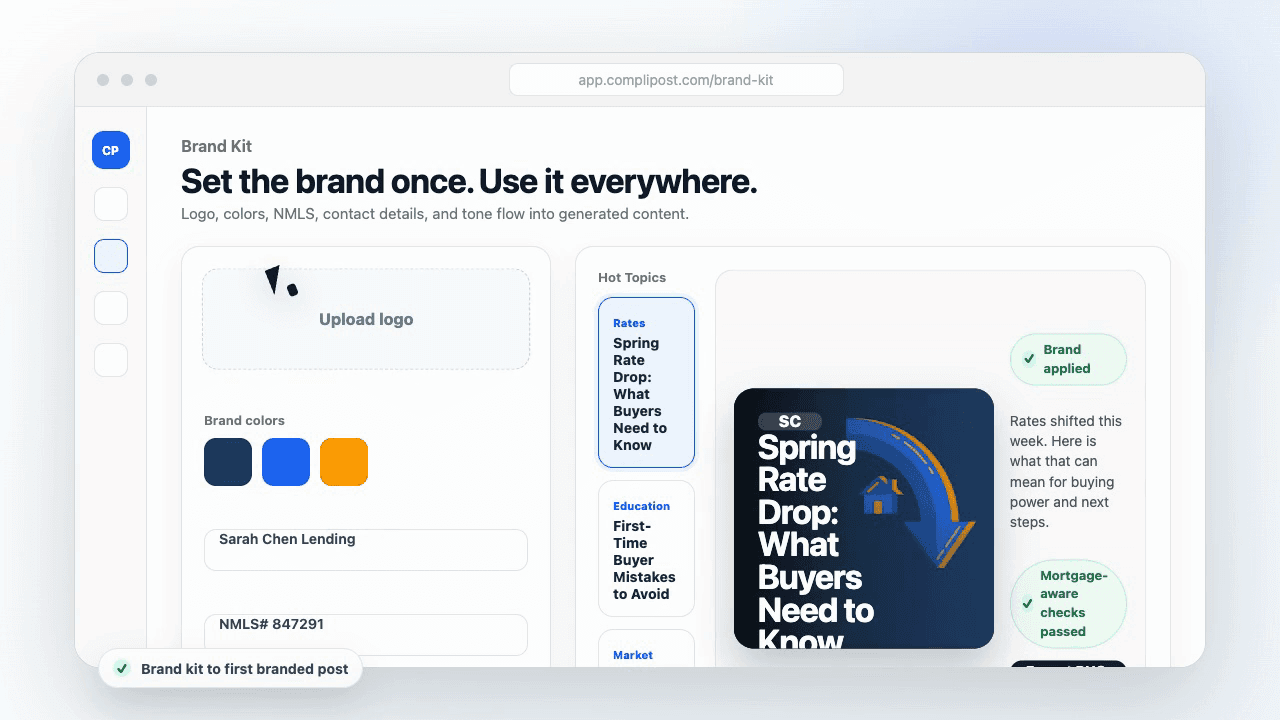
Product workflow
From blank page to export-ready mortgage content
- Start with a borrower topic
- Generate copy and a visual direction
- Review, save, and export the finished asset
These previews reflect the core CompliPost workflow: create, review, save, and export assets for use in your own channels.
Workflow comparison
| Content approach | What happens | Why it matters |
|---|---|---|
| Random posting | One-off ideas created when there is spare time | Inconsistent visibility and weak reuse |
| Template-only posting | Faster design but still requires rewriting and review | Helpful starting point, but not a full system |
| CompliPost workflow | Plan, generate, review, save, and export from one place | Better consistency with mortgage-aware review context |
| Done-for-you service | Someone else creates much of the content | Useful for some teams, but less control and less immediate reuse |
Who this guide helps
This guide is for loan officers working on solo loan officers who need a repeatable mortgage content workflow. The goal is to turn a broad mortgage topic into one borrower question, one useful takeaway, and one asset that can be reviewed before it is shared.
- You need content that sounds like a loan officer, not a generic brand account
- You want examples that can become captions, graphics, GIFs, or PDFs
- You need a clear place to review claims before export
- You want finished work saved for reuse, not lost in a chat thread
A practical workflow for this use case
Start with a narrow scenario, then move through planning, drafting, visual creation, review, and export. For attorney divorce financial recovery mortgage content, that means the topic should be specific enough that a borrower or referral partner can immediately understand what decision the content helps with.
- Choose the borrower type, loan topic, or platform before generating copy
- Draft the caption and visual together so the asset feels cohesive
- Use the federal baseline review aid to flag claims and disclosure gaps
- Export the finished asset and save the post as a reusable starting point
What makes the content stronger
Strong mortgage content is usually specific, plain-spoken, and calm. It explains tradeoffs without pretending one answer fits every borrower. That is especially important on public social channels, where a short post can be interpreted without the full context of a loan conversation.
- Name the borrower question in the first line
- Explain one decision or tradeoff instead of covering everything
- Use examples without implying approval, savings, or rate outcomes
- End with a soft next step, checklist, or guide rather than pressure
Compliance-aware review notes
CompliPost should be treated as a review aid, not a compliance approval system. The public page, generated draft, graphic, and exported asset should all stay honest about that boundary.
- Review specific payment, APR, rate, savings, and qualification language
- Avoid “best,” “lowest,” “guaranteed,” “free,” and urgency claims unless approved
- Check NMLS, Equal Housing, company, and state-specific requirements
- Use company or legal review for anything outside the federal baseline
How this connects to the rest of CompliPost
A focused guide should leave you with a usable next step. After you understand the topic, you can turn it into a calendar slot, a reviewed social post, a downloadable guide, or a platform-specific version for the channel where your audience already spends time.
- Use the content calendar to turn the idea into a weekly plan
- Use the compliance page when claims or disclosures need a slower pass
- Use lead magnets when the topic deserves a deeper PDF guide
- Use platform pages to adapt the same idea for LinkedIn, Facebook, or Instagram
Recommended next steps
Self-employed borrower hub
Create income-documentation education for self-employed borrowers.
Divorce Recovery Mortgage Content
Comprehensive content on post-divorce mortgage qualification and recovery strategies.
Attorney Mortgage Guide
Full guide for attorney borrowers across all life circumstances.
Credit Score and Mortgage Approval
Detailed explanation of credit score impact and recovery strategies.
Examples
"Attorney, divorce finalized 18 months ago, credit score recovered from 580 to 680, just closed on a home. Here's the recovery path."
Share as an inspiring case study with realistic recovery timeline.
"Post-divorce credit damage: here's what matters for mortgage qualification and how to rebuild."
Create an educational post on post-divorce credit recovery.
"Alimony, child support, and mortgage qualification: here's the DTI math that matters."
Write as a detailed breakdown of how support obligations affect borrowing power.
"Financial recovery after divorce: timeline, strategy, and when to buy a home."
Comprehensive guide for attorneys navigating post-divorce homeownership.
FAQ
How long after my divorce should I wait before applying for a mortgage?+
Ideally, wait 12-18 months. Divorce typically damages credit and finances; waiting gives you time to: (1) repair credit damage; (2) establish clean payment history post-divorce; (3) accumulate down payment savings; (4) achieve financial stability. If you apply too soon after divorce, you'll face higher rates and stricter underwriting due to recent damage. If you can wait 12+ months, you'll qualify for better terms and more favorable underwriting. That said, if your divorce was amicable and financial damage was minimal, you may be ready sooner. Talk to a loan officer 6-9 months after divorce to assess readiness; they'll tell you realistically whether waiting makes sense.
Do I have to disclose my divorce in a mortgage application?+
You don't have to volunteer information, but you must answer questions truthfully. If the application asks about recent major life changes, legal events, or if your credit report shows marital dissolution legal actions, disclose it. Lenders pull your credit, so they may see evidence of divorce. Being upfront ("I was recently divorced and am rebuilding my financial situation") is better than appearing to hide it. Divorce isn't disqualifying; many people buy homes post-divorce. What matters is your current financial stability and credit recovery. A transparent explanation shows confidence in your recovery, which lenders respect.
How do alimony and child support payments affect my mortgage qualification?+
They count as debt obligations in your DTI calculation. If you pay $2,000/month in spousal and child support, that $2,000 is subtracted from your income when calculating what mortgage payment you can afford. This may reduce your borrowing power. However, if you're receiving support (rather than paying), some lenders count that as additional income—subject to documentation. Bring your divorce decree showing the support amount, court order documentation, and evidence of consistent payment or receipt (bank statements). The clearer the documentation, the easier it is for lenders to factor correctly.
What if the divorce decree assigns me the marital home but with a mortgage I can't qualify for?+
This is a common post-divorce challenge. If you received the home in the settlement but can't qualify for a new mortgage in your name alone, you have a few options: (1) refinance with your ex still on the loan (if lenders allow and both agree); (2) wait until your credit recovers and income is stable enough to refinance; (3) sell the home and buy something you can afford post-divorce. Many attorneys delay refinancing the marital home into their sole name until they've rebuilt credit (12-18 months post-divorce). Once credit is recovered and income is stable, they refinance. Talk to your divorce attorney and your loan officer; they can help you plan the refinance timeline and strategy.
Can my ex still be liable for the marital home mortgage if I got it in the divorce?+
This depends on your divorce agreement and the lender's consent. A divorce decree can assign the home to you and require your ex to be removed from the mortgage. However, the lender must agree to remove them. Most lenders require you to refinance into your sole name to release your ex from liability. Until you refinance, your ex is technically still on the original loan and potentially liable. This is why post-divorce refinancing is important: it removes your ex from the legal obligation and lets you move forward independently. Discuss the refinancing timeline with your divorce attorney and loan officer; they'll coordinate the removal.
Create mortgage content with a calmer workflow
CompliPost helps you plan, generate, review, save, and export useful mortgage content without pretending compliance or social distribution is automatic.
Start free