Legal Professional
Mortgage Content for Attorneys Rebuilding Credit
Attorneys aren't immune to credit challenges. Divorce, business setbacks, student loan struggles, or temporary missed payments can hit credit scores. Your content for this segment should normalize credit repair and show that qualified attorneys with damaged credit can still purchase homes—with strategy, time, and the right loan officer.
How much does credit damage affect an attorney's mortgage qualification?
Credit scores matter, but they're not everything—especially for well-documented, high-income borrowers like attorneys. Social content should normalize credit repair and show that recovery is possible.
- Credit score is one factor: income, assets, and employment matter too; lenders don't reject high-income borrowers solely on score
- Late payments impact is temporary: newer late payments hurt more than older ones; time heals many credit issues
- Bankruptcy recovery: Chapter 7 and Chapter 13 bankruptcies require waiting periods (2-4 years), but you can buy after if income and payment history are clean
- Collections accounts: paid-off collections hurt less than unpaid; newer is worse than older
- Divorces and business setbacks: lenders understand that life happens; they want to see recovery, not judgment
What's the path to mortgage qualification after credit damage?
There is a path. Content should show the specific steps and timeline for credit recovery and mortgage requalification.
- Assess the damage: pull your credit report and understand the specific issues (late payments, collections, bankruptcy, high utilization)
- Create a repair plan: pay down balances, bring accounts current, dispute errors on your report, avoid new negative marks
- Demonstrate recovery: 12-24 months of clean payment history after damage begins to offset the negative impact
- Build reserves: high-income borrowers with strong cash reserves may qualify sooner than lower-income borrowers with identical credit damage
- Choose the right loan program: some programs are more forgiving of credit damage than others; find the best fit
What messaging helps attorneys recover from credit damage?
Attorneys with credit damage often feel shame or embarrassment. Content should normalize the challenge and position recovery as a realistic goal.
- Acknowledge that credit damage happens: divorce, business setbacks, illness—these affect everyone, including successful attorneys
- Show recovery timelines: specific examples of attorneys who bought homes 18-24 months after credit damage
- Offer practical credit repair guidance: what actions move the needle on credit recovery
- Position yourself as non-judgmental: you understand that a credit score doesn't define a person or their ability to repay
- Share stories of recovery: real borrowers who worked through credit challenges and achieved homeownership
How do you help attorneys strategically repair credit and plan for mortgage qualification?
Export content that guides attorneys through credit repair and sets realistic expectations for the mortgage timeline. This is where you add real value and build trust.
- Create a credit repair checklist: what to do immediately, what to do over time, what to track
- Develop content on mortgage programs for borrowers with credit challenges: FHA, portfolio loans, etc.
- Build email sequences that guide credit repair over 12-24 months and check in on progress
- Offer a free consultation: assess credit damage and create a realistic timeline to mortgage qualification
- Export content as downloadable guides on credit repair and mortgage readiness after financial difficulty
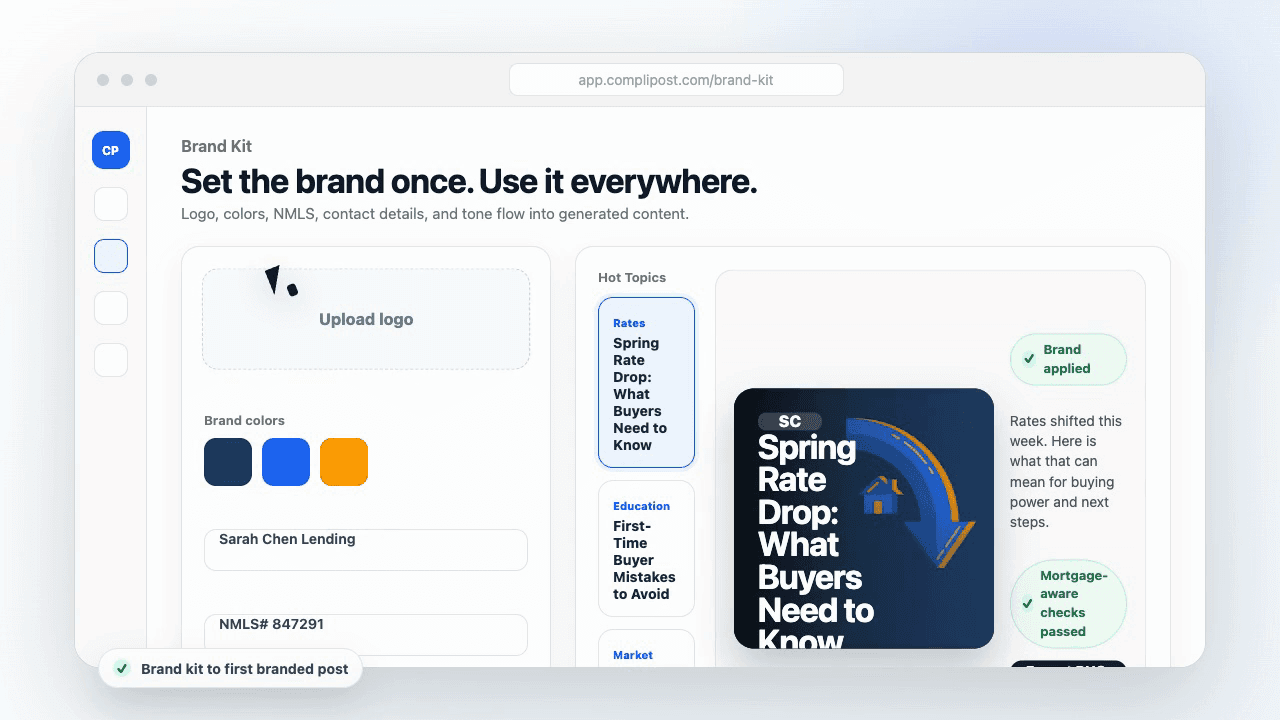
Product workflow
From blank page to export-ready mortgage content
- Start with a borrower topic
- Generate copy and a visual direction
- Review, save, and export the finished asset
These previews reflect the core CompliPost workflow: create, review, save, and export assets for use in your own channels.
Workflow comparison
| Content approach | What happens | Why it matters |
|---|---|---|
| Random posting | One-off ideas created when there is spare time | Inconsistent visibility and weak reuse |
| Template-only posting | Faster design but still requires rewriting and review | Helpful starting point, but not a full system |
| CompliPost workflow | Plan, generate, review, save, and export from one place | Better consistency with mortgage-aware review context |
| Done-for-you service | Someone else creates much of the content | Useful for some teams, but less control and less immediate reuse |
Who this guide helps
This guide is for loan officers working on solo loan officers who need a repeatable mortgage content workflow. The goal is to turn a broad mortgage topic into one borrower question, one useful takeaway, and one asset that can be reviewed before it is shared.
- You need content that sounds like a loan officer, not a generic brand account
- You want examples that can become captions, graphics, GIFs, or PDFs
- You need a clear place to review claims before export
- You want finished work saved for reuse, not lost in a chat thread
A practical workflow for this use case
Start with a narrow scenario, then move through planning, drafting, visual creation, review, and export. For attorney credit repair mortgage recovery content, that means the topic should be specific enough that a borrower or referral partner can immediately understand what decision the content helps with.
- Choose the borrower type, loan topic, or platform before generating copy
- Draft the caption and visual together so the asset feels cohesive
- Use the federal baseline review aid to flag claims and disclosure gaps
- Export the finished asset and save the post as a reusable starting point
What makes the content stronger
Strong mortgage content is usually specific, plain-spoken, and calm. It explains tradeoffs without pretending one answer fits every borrower. That is especially important on public social channels, where a short post can be interpreted without the full context of a loan conversation.
- Name the borrower question in the first line
- Explain one decision or tradeoff instead of covering everything
- Use examples without implying approval, savings, or rate outcomes
- End with a soft next step, checklist, or guide rather than pressure
Compliance-aware review notes
CompliPost should be treated as a review aid, not a compliance approval system. The public page, generated draft, graphic, and exported asset should all stay honest about that boundary.
- Review specific payment, APR, rate, savings, and qualification language
- Avoid “best,” “lowest,” “guaranteed,” “free,” and urgency claims unless approved
- Check NMLS, Equal Housing, company, and state-specific requirements
- Use company or legal review for anything outside the federal baseline
How this connects to the rest of CompliPost
A focused guide should leave you with a usable next step. After you understand the topic, you can turn it into a calendar slot, a reviewed social post, a downloadable guide, or a platform-specific version for the channel where your audience already spends time.
- Use the content calendar to turn the idea into a weekly plan
- Use the compliance page when claims or disclosures need a slower pass
- Use lead magnets when the topic deserves a deeper PDF guide
- Use platform pages to adapt the same idea for LinkedIn, Facebook, or Instagram
Recommended next steps
Self-employed borrower hub
Create income-documentation education for self-employed borrowers.
Bankruptcy Recovery Mortgage
Specific content addressing post-bankruptcy mortgage qualification and timelines.
Attorney Mortgage Guide
Comprehensive guide for attorney borrowers covering all scenarios, including credit challenges.
How Credit Score Affects Mortgage Approval
Detailed explanation of credit score impact on mortgage qualification and rates.
Examples
"Attorney, bankruptcy 2 years ago, rebuilt credit to 680, just closed on a home. Here's what changed her application."
Share as a case study on LinkedIn with realistic timeline and recovery steps.
"Divorce derailed your credit score? Here's the timeline to mortgage qualification and what lenders need to see."
Create a detailed guide addressing credit damage from life events.
"Late payments, collections, high utilization—and you still qualify for a mortgage. Here's why and how."
Educational post explaining that credit damage isn't permanent disqualification.
"Your credit story matters. Here's how to present credit damage to lenders and move forward."
Write as a strategic guide for explaining credit challenges in mortgage applications.
FAQ
How long after a bankruptcy can I buy a home?+
Typically 2-4 years after discharge, depending on the bankruptcy type and the lender. Chapter 7 bankruptcy (liquidation) requires a 2-year waiting period; Chapter 13 (reorganization) is typically 1-2 years after discharge, sometimes while still in the plan. However, waiting periods are minimums, not guarantees. Lenders also want to see clean payment history after discharge and evidence of financial recovery. After the waiting period, you can apply if you have: documented income, employment stability, a reasonable down payment (20% helps), good credit recovery progress, and assets or reserves. Waiting periods vary by lender; some are more flexible than others. Work with a loan officer experienced in credit repair to understand your specific path.
Can I buy a home with a credit score below 620?+
Possibly, but it's harder and more expensive. Most conventional mortgages require a 620+ score. FHA loans allow scores in the 500-600 range but require larger down payments and mortgage insurance. Some portfolio lenders and non-traditional programs work with lower credit scores if you have strong income and assets. If your score is below 620, focus on credit repair: pay down balances, bring any late accounts current, dispute errors, and build new positive payment history. In 6-12 months of effort, you could improve your score 50-100 points, opening more options and better rates. Talk to a credit-focused loan officer; they can assess your specific situation and recommend the best path forward.
How do I explain late payments or collection accounts in my mortgage application?+
Explain, don't hide. Provide a brief written explanation of what happened (divorce, job loss, medical emergency, etc.), when it occurred, and how you've resolved it since. If you've paid collections or brought late accounts current, document that. Lenders understand that financial challenges happen; they want to see that you've addressed the issue and are moving forward. For older late payments (3+ years), they matter less. For recent late payments (within 2 years), they hurt more. The key: demonstrate that the issue was specific to that time and that you're now stable. Recent clean payment history is your strongest counter-argument to past damage.
What's the difference between a short sale, foreclosure, and bankruptcy in terms of mortgage qualification timeline?+
Short sale: 3-year waiting period from sale date; less damaging than foreclosure. Foreclosure: 3-year waiting period (sometimes longer for FHA); more damaging than short sale. Bankruptcy: 2-4 years depending on chapter (see above). After the waiting period, all three allow mortgage qualification if you have clean income history, stable employment, and documented recovery. Foreclosure and bankruptcy carry heavier stigma and may require larger down payments or proof of cash reserves. Short sales are viewed somewhat more favorably. The timeline is important, but so is what you've done since: job stability, payment history, savings. Work with a lender experienced in post-foreclosure qualification; they'll navigate the process and find the best program for your situation.
Should I try to pay off collection accounts before applying for a mortgage?+
Sometimes yes, sometimes no—and it's counterintuitive. Paying off an old collection account can actually ding your credit score in the short term (it shows recent activity on a negative account). However, paying off recent collections or bringing current accounts past-due *is* a good idea. The strategy depends on your specific situation: what accounts, how old, how recent the damage. Consult a credit-focused loan officer or credit counselor before making moves. In some cases, you're better off leaving old collections alone and focusing on building new positive history. In other cases, paying collections strengthens your application. Don't guess; get expert advice before taking action.
Create mortgage content with a calmer workflow
CompliPost helps you plan, generate, review, save, and export useful mortgage content without pretending compliance or social distribution is automatic.
Start free